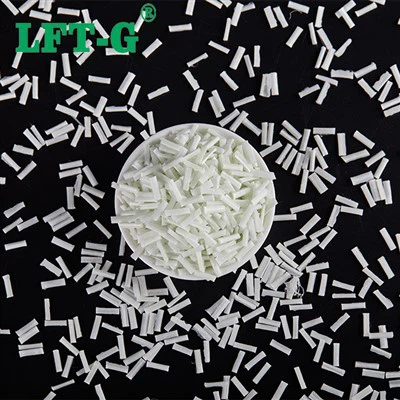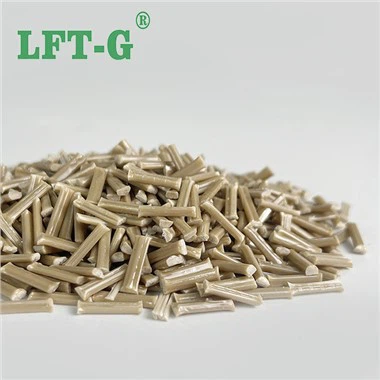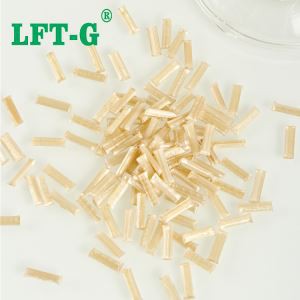

Since polypropylene is incompatible with long glass fibers, it is difficult to form a good interfacial bond strength during the compounding process. The poor compatibility is mainly reflected in the difference in density and fluidity between the substrate and the glass fiber. The dispersion of the fiber in the matrix is poor. When the melt flows in the mold, the long glass fiber is easily separated from the substrate and stays on the surface of the workpiece, causing the appearance of the workpiece. bad.

Fiber distribution in the direction of injection molding of fiber reinforced polypropylene
In order to effectively solve the interfacial compatibility of glass fiber reinforced materials, XIAMEN LFT COMPOSITE PLASTIC CO., LTD. independently developed fiber surface grafting treatment technology, which greatly improved the compatibility of long glass fiber and resin matrix. Using a processing aid such as a dispersant, a lubricant, and an anti-glass fiber exposure agent to increase the coating power of the resin for each fiber, and to enhance the fluidity of the glass fiber, thereby forming an interface layer between the fiber and the matrix to form a good watch. At the same time, it effectively prevents problems such as fiber exposure on the surface of the workpiece and serious floating fibers.

50% GF long glass fiber particle injection molding glass fiber dispersion and floating fiber state