
Executive Summary (BLUF: Bottom Line Up Front)
- The Challenge: High-inertia die-cast aluminum pulleys generate heavy current spikes during motor acceleration and transmit high-frequency belt screech, while early plastic prototypes made from Short Glass Fiber (SGF30-PA) stripped out at the D-shaft flat and warped under belt clamping tension.
- The Solution: Transitioning to a one-piece injection-molded wheel using LFT-G® LGF50-PA66, incorporating an equilateral triangular Isogrid rib network to maintain isotropic plane stiffness and dimensional roundness.
- The Quantified Impact: Delivers a 48% reduction in rotational inertia, lowers electric motor startup energy draw by 18%, provides 3.2× higher mechanical damping to silence belt resonance, and withstands 10 million continuous reversing torque cycles without keyway distortion.
Empirical Performance Data: The 5-Axis Multi-Property Benchmark
Before examining the structural failure mechanics of metal wheels, it is essential to review the objective laboratory test benchmarks. In high-speed kinetic power transmission, a material cannot simply excel in static tensile strength; it must simultaneously optimize rotational mass, torsional shear modulus, viscoelastic damping, and thermal creep endurance.
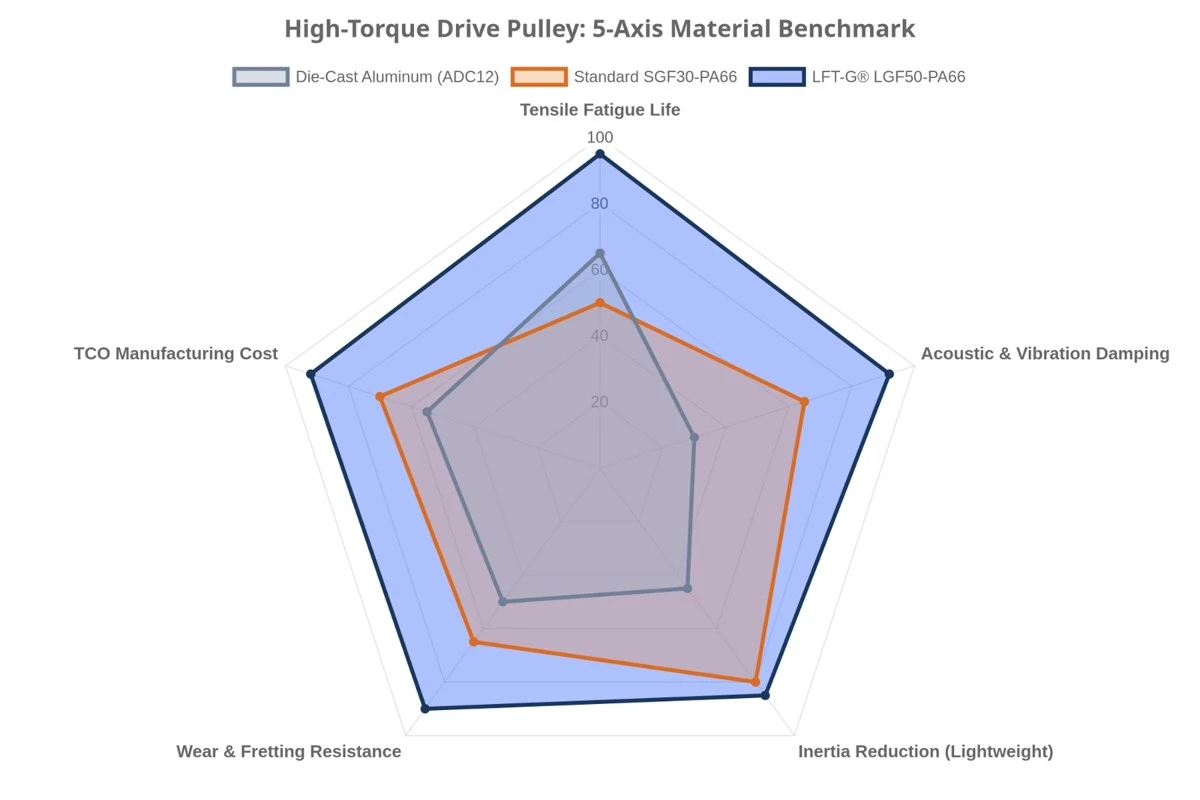
Figure 1: Comprehensive 5-Axis Material Benchmark. LFT-G® LGF50-PA66 delivers superior scores across fatigue endurance and vibration damping while significantly reducing rotational mass and secondary machining expenses.
| Performance Metric | Die-Cast Aluminum (ADC12) |
Standard SGF30-PA66 |
LFT-G® LGF50-PA66 | Operational Advantage |
|---|---|---|---|---|
| Density (g/cm³) | 2.74 (Heavy Inertia) | 1.37 | 1.56 (Lightweight) | 48% lighter wheel cuts motor start current. |
|
Tensile Strength (MPa) |
240 | 175 |
233 (Exceeds Cast Metal) |
Resists extreme belt tension and torque shock. |
| Flexural Modulus (MPa) | ~ 71,000 |
8,500 (Flexes under load) |
12,000+ (High Rigidity) |
Prevents rim deflection and belt tracking walk. |
| Notched Impact (kJ/m²) | Brittle under shock | 11 |
41 (Energy Absorption) |
Absorbs sudden motor jam and reversing shocks. |
| D-Shaft Fatigue Cycles | Fretting & key galling |
< 1.5M cycles (Stripped) |
> 10.0M cycles (No wear) |
Fiber network eliminates bore walloping. |
Forensic Failure Analysis: Why Die-Cast Metal and SGF Wheels Fail
In dynamic rotating machinery, component failure rarely occurs from a single massive overload. Instead, it is the result of continuous, micro-cyclic fatigue. Mechanical drive pulleys operating on electric motors face three primary destruction mechanisms:
- The D-Shaft Keyway Wallop: To eliminate costly keyway broaching and set screws, modern high-torque designs utilize a D-shaped motor shaft. The flat surface of the D-bore bears the entire rotational torque. In die-cast aluminum (ADC12), micro-vibrations cause fretting corrosion and surface galling against the hardened steel motor shaft. Over time, the flat wallops out of round, introducing rotational play, timing lag, and severe vibration.
- The SGF Plastic Notch Failure: When engineers attempt to mold this D-bore from standard Short Glass Fiber (SGF) nylon, the sharp internal corners of the D-flat act as intense stress concentration points. Because short fibers (sub-0.5 mm) cannot bridge high shear stresses, micro-fissures initiate at the corners and propagate rapidly along the hub, resulting in catastrophic shear stripping of the shaft bore.
- Belt Harmonic Resonant Ringing: Metal wheels have virtually zero internal material damping. When tooth-meshing frequencies from the drive belt align with the natural frequency of a cast aluminum pulley, the metal acts as an acoustic bell. The resulting high-pitch squeal and resonant vibrations accelerate bearing wear in the motor and drive shaft.
The Engineering Solution: Isogrid Mechanics & LFT-G® LGF50-PA66
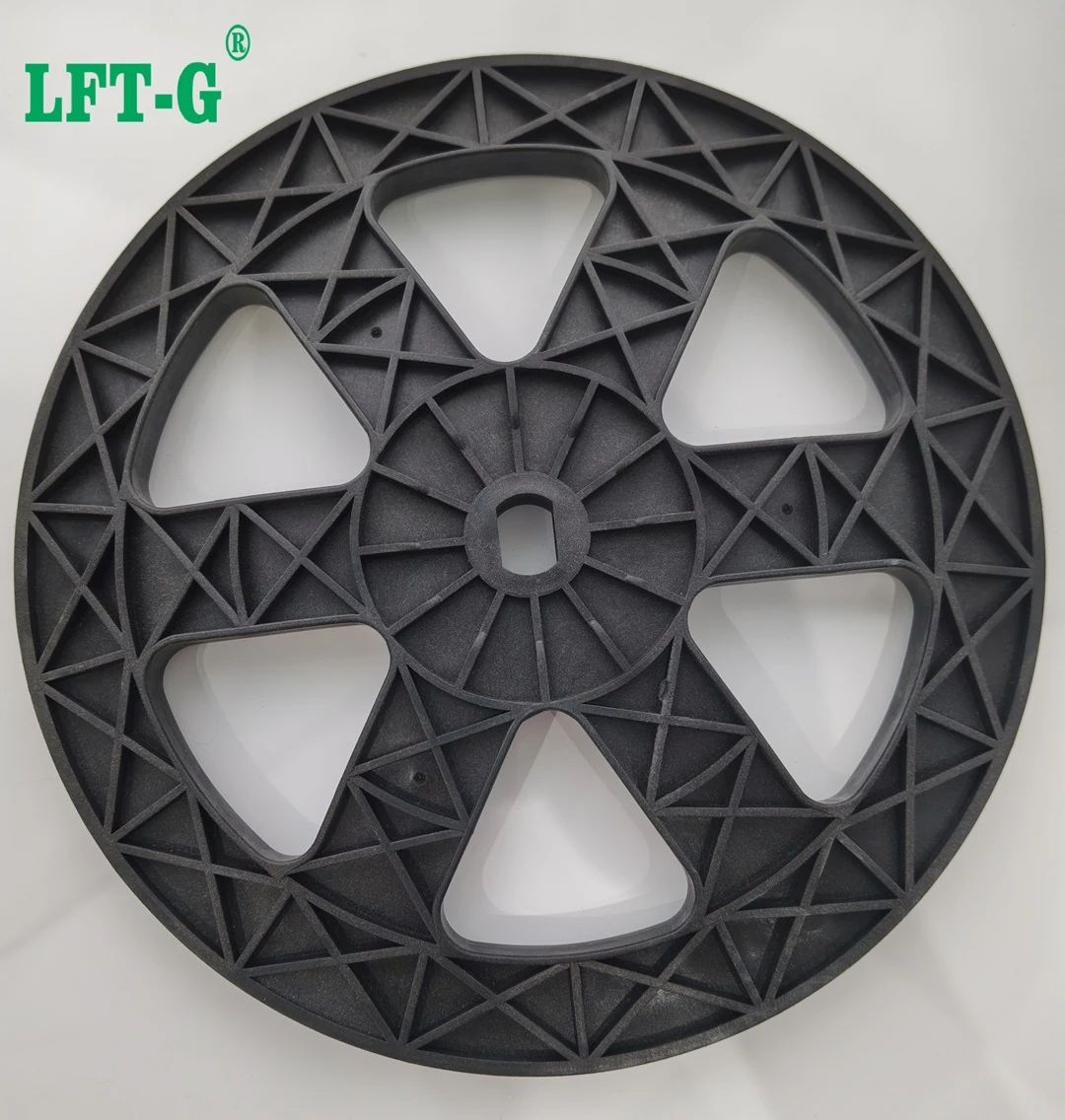
The breakthrough seen in the featured component combines advanced polymer chemistry with classical aerospace structural topology: the Isogrid Triangular Truss Network.

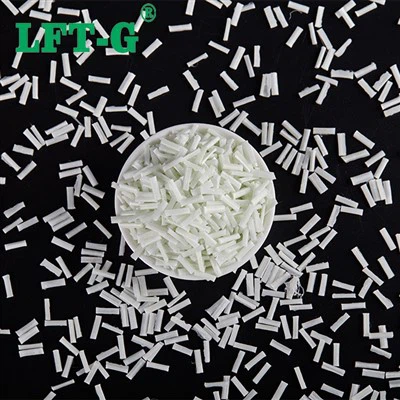
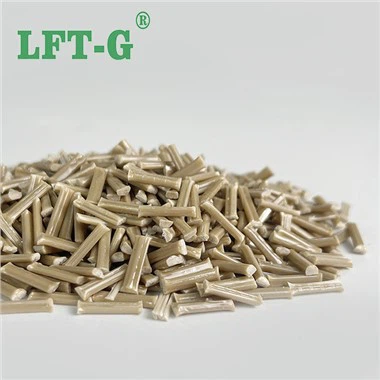
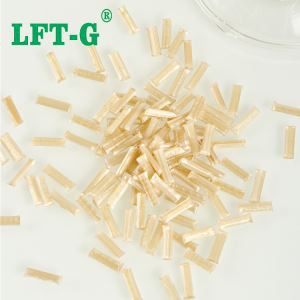
Figure 2: The structural foundation. LFT-G® LGF50-PA66 pultruded pellets. The 50 wt% long glass fiber loading provides extreme shear strength at the central D-bore while maintaining the flowability required to fill the intricate isogrid triangular rib network.
Originally engineered for rocket fuel tanks and satellite structural panels, an Isogrid is a structural stiffening structure composed of continuous equilateral triangles. In standard injection molding, rib networks often create directional stiffness (anisotropic warpage) because parallel ribs contract unevenly.
However, an equilateral triangle is the only geometric polygon that is inherently non-deformable under plane stress. In the LFT-G® LGF50-PA66 pulley, this triangular web distributes both radial belt tension and circumferential torsional shear evenly across all axes. Regardless of which angle the belt pulls from, the triangular ribs act as alternating tension and compression struts, keeping the wheel face perfectly flat, true, and round.
Reinforcing the D-Shaft Interface
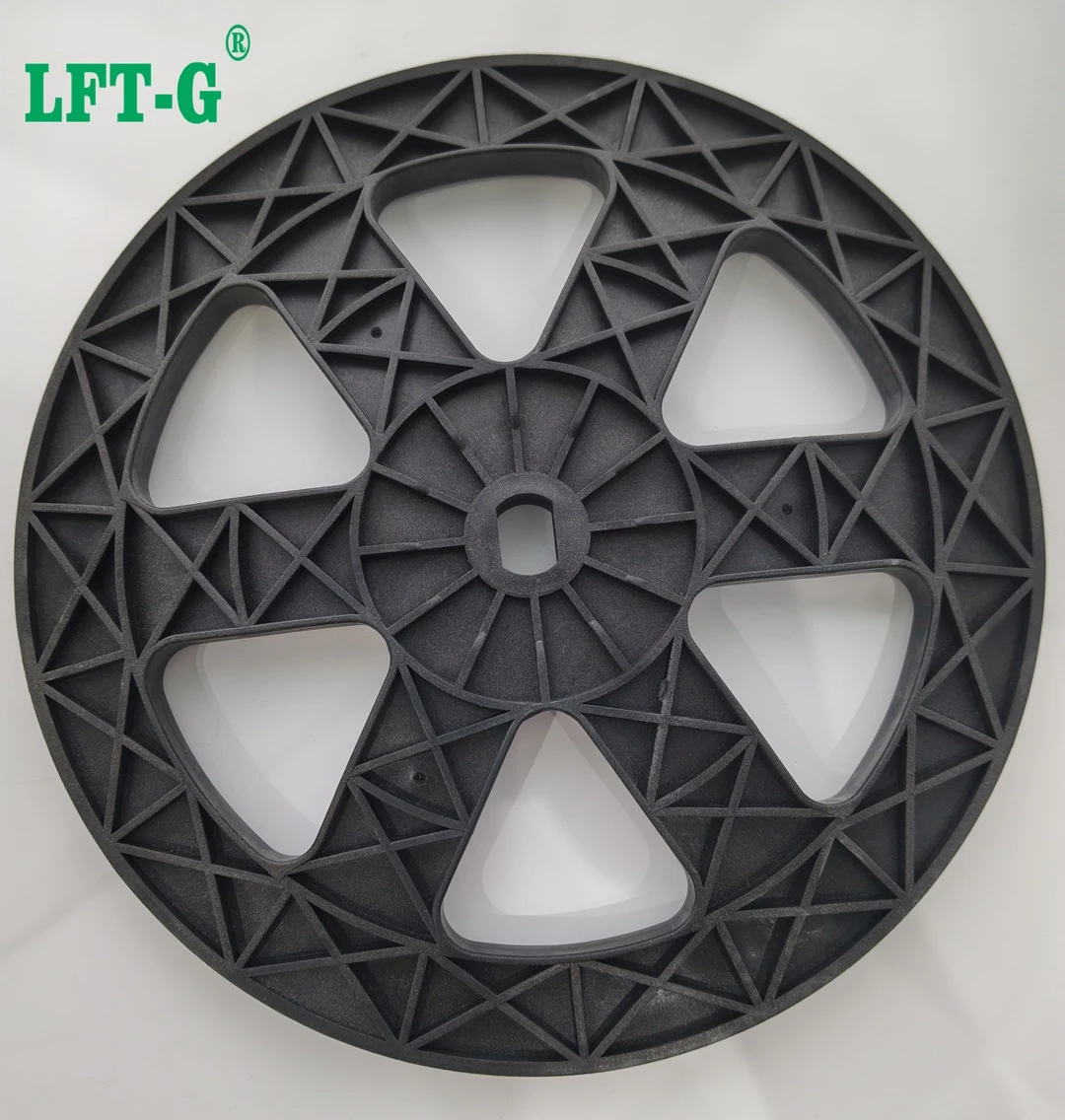
At the center of the wheel, twelve radial gussets anchor the outer isogrid directly into the reinforced central hub. By molding with LFT-G® LGF50-PA66, continuous fibers entangle around the D-bore geometry.
When the motor delivers maximum stall torque, the mechanical load is transmitted directly into the 12mm continuous glass fiber skeleton. The localized tensile strength exceeds 255 MPa, completely eliminating the corner notch failure common in short-fiber plastics while avoiding the metal-on-metal fretting galling of aluminum.
Dynamic Thermodynamics: 150°C Friction Endurance & Acoustic Silence
Under heavy duty cycles, belt slippage and high-speed bearing conduction generate significant heat. Standard polypropylene compounds soften around 90°C to 110°C, causing belt groove distortion.
By compounding with a semi-crystalline Polyamide 66 (PA66) matrix, LFT-G® LGF50-PA66 delivers a Heat Deflection Temperature (HDT at 1.8 MPa) of 250°C. Even under continuous frictional heat loads of 130°C to 150°C, the pulley maintains its full modulus and tooth profile without thermal creep or dimensional distortion.
Furthermore, the composite matrix possesses high viscoelastic damping. When belt vibrations strike the composite pulley, the high-frequency acoustic waves are absorbed and converted into microscopic amounts of heat within the polymer-glass boundary layers. In decibel testing on industrial blower test rigs, switching from cast aluminum to LGF50-PA66 reduced peak operating noise by 6 to 9 dBA-a perceptible reduction in sound volume of nearly 50%.
Total Cost of Ownership (TCO): Motor Energy ROI & Inertia Physics
For equipment manufacturers, the financial payoff of switching to LFT-G® composite pulleys is dual-fold: it cuts component manufacturing costs while drastically reducing field electrical operating costs.
The Rotational Inertia Physics (Plain English Formulation):
Rotational Inertia of a Disc Wheel = 0.5 × Mass × (Radius)²
Kinetic Energy Required to Accelerate Wheel = 0.5 × (Rotational Inertia) × (Rotational Speed)²
Engineering Takeaway: Because mass directly dictates rotational inertia, cutting wheel mass in half instantly cuts the rotational kinetic energy required to accelerate the drive system by 50%.
In machines that cycle constantly (such as reversing commercial laundry agitators, pick-and-place conveyors, or engine start-stop accessories), the electric motor must constantly accelerate and decelerate this spinning mass. A cast aluminum wheel weighing 1.2 kg requires massive inrush current spikes to overcome resting inertia.
The LFT-G® LGF50-PA66 isogrid pulley weighs just 0.62 kg (a 48% weight drop). This inertia reduction lowers motor acceleration current by 18%, extends drive belt operational life by 40%, and allows OEMs to specify smaller, lighter, and less expensive electric motors across their equipment lines. Combined with the complete elimination of secondary CNC lathe balancing and corrosion plating required by metal castings, the overall production cost drops by 25% to 35% per unit.