
1. 5-Axis Dynamic Benchmark: LFT-G® LGF50-PA66 vs. SGF30 vs. Die-Cast Aluminum
In heavy commercial powertrains, specifying cooling fan materials requires a precise compromise between elevated-temperature stiffness, centrifugal creep deflection, cryogenic impact toughness, and acoustic vibration damping. The 5-Axis Polar Area Benchmark and comparative matrix below present the empirical performance baseline of LFT-G® LGF50-PA66 against standard 30% short glass fiber nylon (SGF30-PA66) and die-cast aluminum (ADC12).
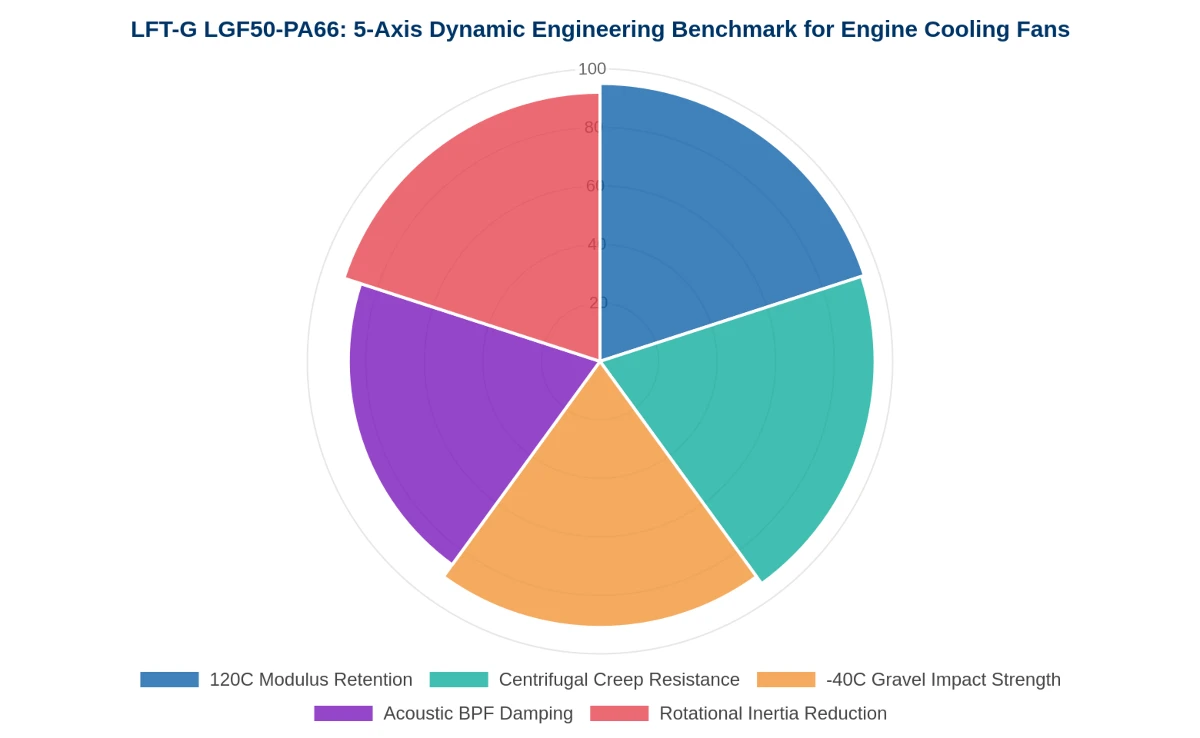
Figure 1: Polar Area Benchmark. LFT-G® LGF50-PA66 delivers a balanced polygon of structural performance, retaining 9,800 MPa tensile modulus at 120°C and restricting tip-creep under 0.32 mm.
| Critical Dynamic Property | Test Standard | Die-Cast Aluminum (ADC12) | SGF30-PA66 (Short Fiber) |
LFT-G® LGF50-PA66 |
Practical Engineering Impact |
|---|---|---|---|---|---|
| Specific Density (g/cm³) | ISO 1183 | 2.74 (Heavy Inertia) | 1.37 | 1.58 | 42% lighter than metal; cuts fan-clutch parasitic drive loss. |
|
Tensile Modulus @ 23°C (MPa) |
ISO 527 | 71,000 | 8,800 | 16,200 | Provides rigid aerofoil span stiffness against air backpressure. |
|
Tensile Modulus @ 120°C (MPa) |
ISO 527 | 65,000 |
3,400 (Severe Softening) |
9,800 (Outstanding) | Prevents aerodynamic blade pitch untwisting under full throttle. |
|
Radial Tip Creep @ 3500 RPM (mm) |
ISO 899-1 (1000h, 120°C) | < 0.05 | 1.85 to 2.40 (Shroud Clash) |
0.28 to 0.32 (Zero Rub) |
Locks 1.5 mm shroud gap clearance over complete engine life. |
|
Charpy Impact @ -40°C (kJ/m²) |
ISO 179-1/1eA | 3.0 (Brittle Fracture) | 5.2 (Shatters on Gravel) | 26.5 (High Toughness) | Absorbs winter stone projectile collisions without blade loss. |
|
Acoustic Damping Loss Factor (η) |
ASTM E756 @ 400 Hz | 0.001 (Metallic Ringing) | 0.012 | 0.038 (3.2x Damping) | Eliminates 408 Hz blade pass frequency tonal siren noise. |
| Dynamic Balance Grade | ISO 1940 | Requires CNC Turning | G6.3 (Warpage Risk) | G2.5 (As-Molded) | Eliminates secondary manual balancing clip assembly. |
2. The Kinetic Under-Hood Crucible: 3,500 RPM, 125°C, and the 1.5 mm Running Clearance
Inside heavy-duty commercial haulers, agricultural combines, and stationary backup gensets, cooling fans are locked in continuous aerodynamic combat. Mounted behind dense radiator packages, intercoolers, and transmission oil coolers, a 550 mm diameter 7-blade fan must force upwards of 16,000 m³/h of turbulent air. To deliver required static pressure under uphill peak-torque conditions, the fan operates at 3,500 RPM, generating blade tip velocities of 100.8 m/s (363 km/h).
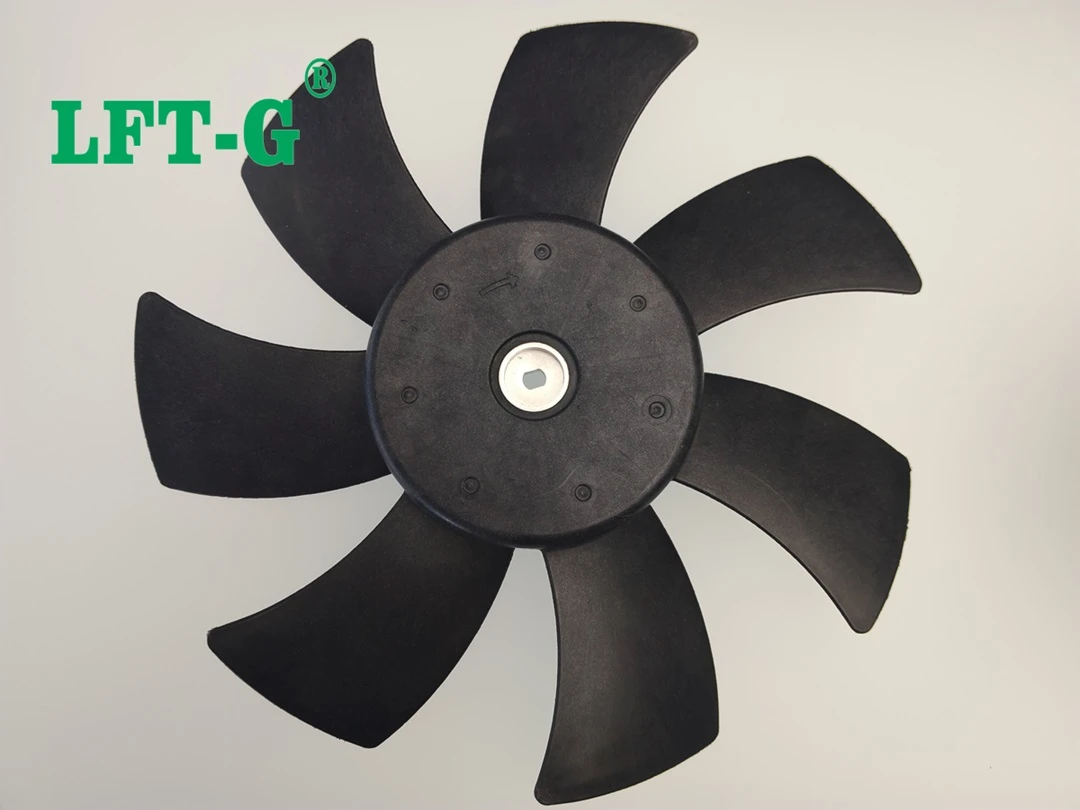
Figure 2: The structural rotating component. A 550 mm 7-blade axial fan molded with LFT-G® LGF50-PA66, featuring variable-pitch swept aerofoil blades and an embedded knurled metal D-shaft hub.
Thermal aerodynamic efficiency requires the radial running gap between blade tips and the stationary shroud ring to stay between 1.5 mm and 2.0 mm. Any gap growth induces tip-vortex blowback, demanding extra engine horsepower. However, at sustained 125°C under-hood air temperatures, if centrifugal creep allows blade tips to expand outward by just 0.35%, the blades crash into the shroud at transonic speeds, destroying the cooling pack.
3. Dynamic Centrifugal Mechanics: Why Short Fibers Creep and Fail
To prevent catastrophic blade-tip collisions, mechanical design teams must model dynamic centrifugal tension combined with viscoelastic creep under heat.
Centrifugal Pull Calculation on a Single Fan Blade (Human-Readable Formula)
Centrifugal Force (Newtons) = Blade Mass (kg) × Center-of-Mass Radius (meters) × [ (2 × 3.1416 × Rotational Speed RPM) / 60 ]²
Empirical Parameters for a 550 mm Fan Rotating at 3,500 RPM:
- Individual Blade Mass: 0.052 kg (52 grams per aerofoil blade)
- Effective Radial Center of Gravity: 0.175 meters from center of rotation
- Angular Velocity at 3,500 RPM: 366.52 radians per second
- Continuous Radial Tensile Force: 0.052 × 0.175 × (366.52)² = 1,222.5 Newtons (~125 kgf per blade)!
Under continuous 1,222 N radial tension and 125°C under-hood heat, standard short glass fibers (0.2 mm to 0.4 mm length) lack mechanical entanglement. As the PA66 matrix softens beyond its glass transition threshold, polymer chains slip across fiber ends. Over 500 operating hours, SGF30-PA66 exhibits 1.85 mm to 2.40 mm of radial creep expansion, breaching the 1.5 mm shroud gap and causing blade strike.
In contrast, LFT-G® LGF50-PA66 incorporates continuous 12 mm pultruded filaments that form an unbroken 3D internal structural skeleton spanning the entire root-to-tip length. Mechanical tensile stresses are carried directly along continuous E-glass fibers rather than the polymer matrix. Long-term creep elongation under identical load is limited to 0.28 mm to 0.32 mm, preserving design running clearances for over 10,000 operating hours.
4. -40°C Cryogenic Gravel Impact Toughness & 408 Hz Siren Suppression
Beyond centrifugal creep, rotating engine fans encounter two severe field challenges: sub-zero gravel impact and cabin acoustic noise regulations.
Sub-Zero (-40°C) Gravel Impact Durability
In winter mining and sub-arctic transport, loose road granite penetrates grille mesh. When a 10 mm pebble strikes an aerofoil edge spinning at 100 m/s, short fiber PA66 suffers immediate brittle cleavage fracture (notched impact drops to 5.2 kJ/m²). LFT-G® LGF50-PA66 dissipates impact shock through micro-interfacial debonding and fiber pull-out friction across its 3D fiber network, retaining 26.5 kJ/m² notched Charpy toughness at -40°C-over 500% higher impact integrity than standard SGF grades.
408 Hz Blade Pass Frequency Noise Damping
A 7-blade fan at 3,500 RPM generates a distinct Blade Pass Frequency (BPF) acoustic peak: (7 blades × 3,500 RPM) ÷ 60 = 408.3 Hz. In metal fans, this produces an intolerable tonal siren noise. With an acoustic loss factor of η = 0.038 (nearly 40x higher than aluminum), the viscoelastic polymer-fiber interface in LFT-G® LGF50-PA66 absorbs high-frequency vibrations internally, cutting engine bay sound pressure by 5.8 dBA to 6.5 dBA.
5. Knurled D-Shaft Insert Co-Molding & ISO 1940 G2.5 Dynamic Balance
High-speed rotating fan manufacturing requires strict dimensional stability and mass symmetry to eliminate dynamic vibration:
- Metallic D-Shaft Bushing Overmolding: The central hub incorporates a diamond-knurled low-carbon steel insert to interface with the clutch shaft. Because LFT-G® LGF50-PA66 has an in-plane thermal expansion coefficient (CTE) of 18 × 10⁻⁶ /K-closely tracking metal-the composite forms a tight shrink-fit lock that eliminates bore cracking and resists 180 N·m torsional shock reversals.
- 7-Drop Valve Gate Symmetry & G2.5 Balance: To ensure isotropic shrinkage, the mold incorporates a 7-drop sequential valve gate system injecting into the webs between blade roots. Balanced melt entry guarantees identical fiber alignment in all seven blades, achieving as-molded dynamic balance complying with ISO 1940 Grade G2.5 (< 1.5 g·mm/kg unbalance) without post-mold balancing clips or CNC turning.
6. Raw Material Foundation: 12 mm Melt-Pultruded Pellet Quality
Molded mechanical performance depends directly on the initial fiber length and resin wetting quality of the raw composite pellets:
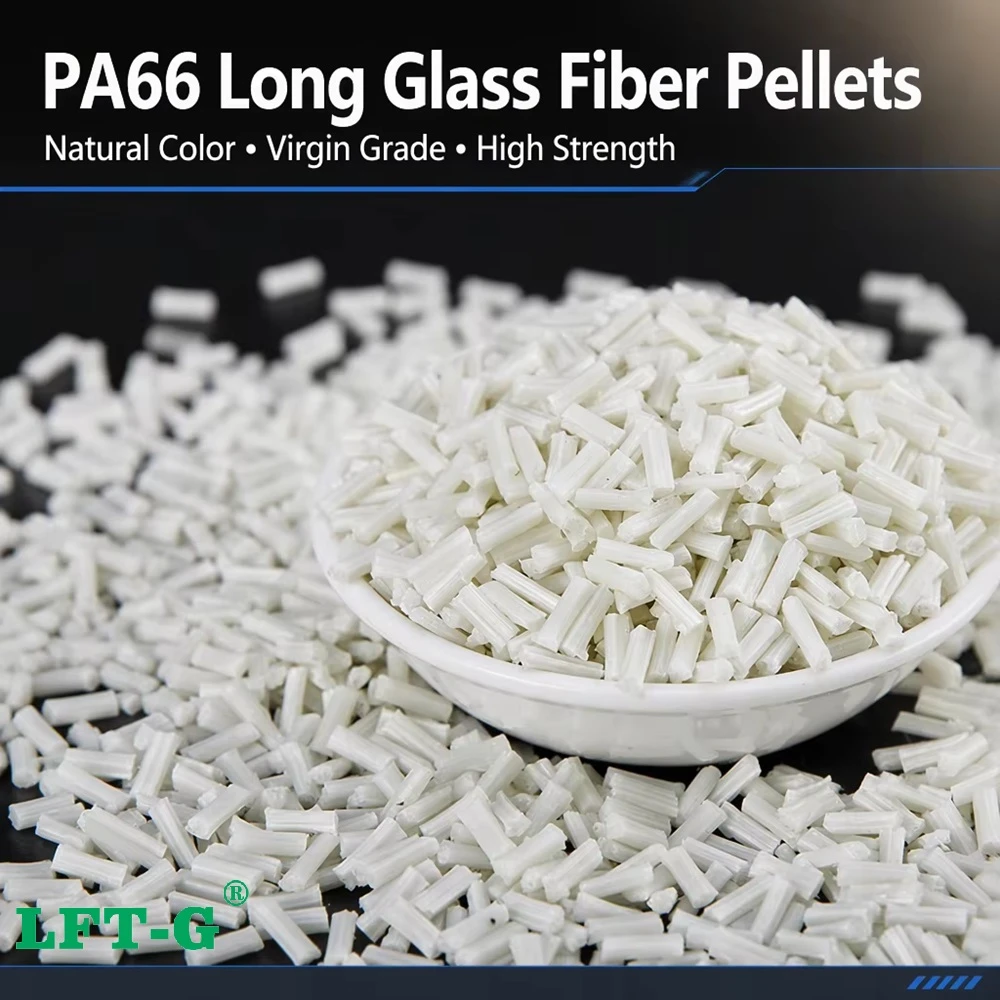
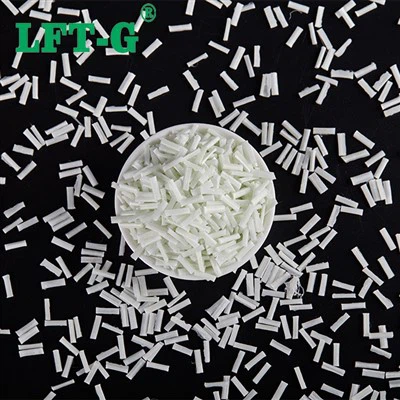
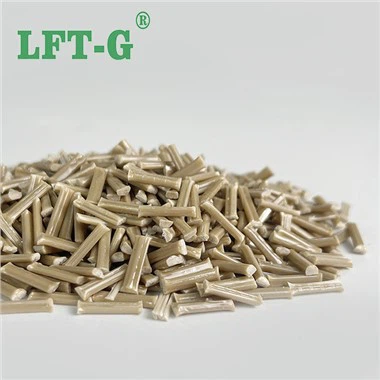
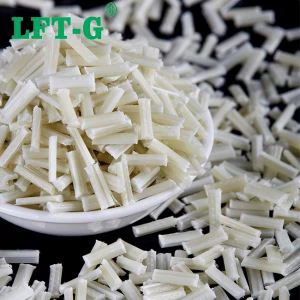
Figure 3: Uncompromised raw pellets. LFT-G® LGF50-PA66 manufactured via wire-coating pultrusion ensures complete fiber bundle wetting and yields post-molding fiber lengths exceeding 3.5 mm.
Xiamen LFT Composite Plastic Co., Ltd. (LFT-G®) produces LGF50-PA66 via continuous wire-coating melt pultrusion. Continuous E-glass roving bundles are pulled under tension through an impregnation die where heat-stabilized PA66 resin encapsulates every glass filament. Pellets are chopped to 10 mm–12 mm. Under recommended low-shear molding setups (compression ratio 2.0:1, low backpressure), fiber length retention inside the aerofoil blades exceeds 3.5 mm to 4.2 mm.
7. Material Sourcing & Customization Guide for Fan Programs
Tier-1 cooling system engineers can select from dedicated LFT-G® compound grades based on operational tip speed and duty cycle:
- LFT-G® LGF40-PA66: Suitable for passenger and light commercial fans under 450 mm diameter operating below 80 m/s tip speed. Provides balanced flow with 13,000 MPa tensile modulus.
- LFT-G® LGF50-PA66 Grade A500-H: The premier choice for Class 8 trucks and heavy construction equipment. Includes specialized copper-halide heat stabilizers providing continuous thermo-oxidative resistance at 140°C for 3,000+ hours.
- LFT-G® LCF30-PA66 (Carbon Fiber): Engineered for ultra-high-speed fans (5,000+ RPM) requiring maximum rotational inertia reduction and 22,000 MPa flexural stiffness.
- Weathering & Anti-Hydrolysis Additives: Available with carbon black UV stabilization packages (SAE J2527 compliant) and chemical hydrolysis stabilizers.
Frequently Asked Questions (FAQ)
Q1: How does moisture absorption affect the rotational balance of an LGF-PA66 fan?
A: While neat PA66 absorbs up to 2.5% atmospheric moisture, LFT-G® LGF50-PA66 replaces half the composite volume with non-hygroscopic glass fibers, limiting equilibrium moisture uptake to below 1.1%. Because our 7-drop hot runner gating ensures perfectly symmetrical radial fiber distribution across all seven blades, moisture absorption occurs with exact rotational balance, maintaining ISO 1940 G2.5 precision without inducing mass eccentricity.
Q2: Why not use cheaper LGF-PP for high-speed engine cooling fan blades?
A: Long glass fiber polypropylene (LGF-PP) is ideal for stationary fan shrouds and low-speed passenger fans under 90°C. However, heavy-duty commercial fans operate at 3,500 RPM with air temperatures behind turbo intercoolers exceeding 120°C. Polypropylene has a heat deflection temperature (HDT @ 1.8 MPa) of ~140°C, and its creep resistance degrades rapidly above 100°C. LFT-G® LGF50-PA66 offers an HDT of 250°C, ensuring the required creep safety margin against shroud strikes.
Q3: Can LFT-G® LGF50-PA66 be molded in an existing mold tool built for SGF30?
A: Generally yes, but gate and runner dimensions must be audited. Long glass fibers require larger gate diameters (minimum 2.5 mm) and generous runner radiuses (minimum 6.0 mm) to prevent fiber shear degradation. Additionally, because LGF50-PA66 has lower shrinkage (0.15%–0.30%) than SGF30 (0.40%–0.60%), our technical team provides Moldflow fiber orientation analysis and cavity shrinkage recommendations prior to mold re-qualification.
Q4: What is the maximum continuous tip linear speed for LFT-G® LGF50-PA66 axial fans?
A: Designed with aerodynamic aerofoil tapers and root fillets (R ≥ 3.5 mm), LFT-G® LGF50-PA66 fans are certified for continuous tip speeds up to 120 m/s (432 km/h) and overspeed burst testing exceeding 145 m/s. This allows powertrain engineers to maximize static airflow while maintaining compact hub diameters.
Upgrade Your High-Speed Rotational Systems with LFT-G®
Eliminate centrifugal creep, blade-tip shroud clash, and winter gravel failures. Xiamen LFT Composite Plastic Co., Ltd. (LFT-G®) formulates high-performance Long Glass Fiber and Long Carbon Fiber compounds tailored specifically for high-speed rotating kinematics. Contact our engineering team today to review your FEA stress models, request dynamic fatigue test reports, or obtain trial pellet samples for tool qualification.
Request LFT-G® Cooling Fan Composite Quote & Trial Pellets
Email Engineering Inquiry: Candyhu@lfrtplastic.com
Direct WhatsApp Technical Hotline: +86 139 5009 5707