

LGF PA66: Structural Lightweight Material
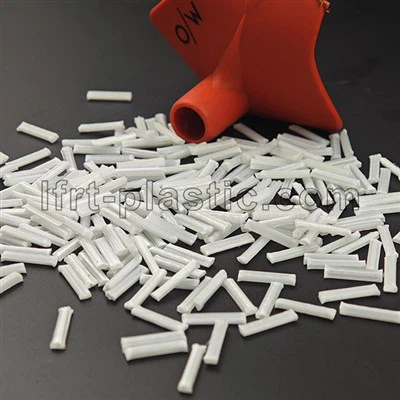
LGF PA66 compound resin (Long Glass Fiber Reinforced Polyamide 66) is a high-performance thermoplastic composite material. Unlike traditional short glass fiber reinforced materials, the glass fibers in the LGF PA66 particles have the same length as the particle length (usually 10 mm - 12 mm or longer). This structure endows it with outstanding mechanical properties.
LGF PA66 is a high-performance engineering plastic composite material. It is produced using long glass fiber reinforcement technology, and maintains a high proportion of effective fiber length even after injection molding. This product is specifically designed for industrial applications that require high strength, lightweight, heat resistance, and chemical corrosion resistance. It can be widely used in automobiles, public transportation, industrial equipment, and electronic and electrical structural components.
What is LGF PA66?
LGF PA66 is an engineering plastic made from PA66 as the matrix and reinforced with long glass fibers (typically 5–25 mm). Compared to short-fiber PA66, it has higher structural strength, impact resistance and dimensional stability.
Product Features and Advantages
High strength and high rigidity
The long glass fibers form a three-dimensional framework structure, enhancing the load-bearing capacity of the components
The bending strength and bending modulus are significantly higher than those of short-fiber reinforced nylon 66
Lightweight design
The material has a low density and can replace some metal structural components.
It supports the requirements for light weighting of automobiles and reduction of weight in industrial equipment.
Excellent impact toughness and fatigue performance
The long fibers can absorb energy when subjected to force, reducing brittle fractures
Improving the durability of components during long-term use
Dimensional stability and heat resistance performance
Low linear expansion coefficient, maintaining structural stability even under long-term high temperatures
Suitable for components in high-temperature environments and with high heat loads
Chemical corrosion resistance
Has good tolerance to oil products, fuel, and common chemicals

Automotive Engineering
Core proposition: Go beyond "replacing steel with plastic", achieving a perfect balance between structural safety and integration.
For the automotive industry, LGF PA66 plastic pellet is not merely a tool for weight reduction, but a key material for realizing modular design and enhancing the NVH performance of the entire vehicle.
True Structural Integrity Replacement
Long glass fibers form an interlaced network within the component, similar to "reinforced concrete". This structure gives the material extremely high specific strength and specific modulus. In the design of front module frames, sunroof frames, and even seat frameworks, LGF PA66 can directly replace die-cast aluminum or stamping steel, achieving weight reduction without the need for corrosion protection treatment like metals.

Outstanding high-temperature creep resistance:
Thanks to the restraining effect of the long fiber network, LGF PA66 plastic pellet exhibits significantly better dimensional stability at high temperatures compared to short glass fiber materials. It ensures that components maintain precise geometric dimensions throughout the vehicle's entire life cycle, even under high temperature and high pressure, guaranteeing the reliable operation of the mechanical system.
Passive Safety and Crash Energy Absorption:
Application: With the increasing requirements for battery protection in new energy vehicles, LGF PA66 compound resin is widely used in battery pack supports and impact beams.
Advantages: During a collision, short glass fiber materials tend to shatter instantly; while LGF PA66 composite can absorb huge impact energy through the extraction of fibers, their fracture, and the plastic deformation of the resin. Even if the matrix breaks, the long fibers still hold the fragments together, maintaining the integrity of the structure.
Industrial & Consumer Goods
Core proposition: "Durability" and "Sophistication" as defined under extreme conditions
For this group, the materials must stand the test of time and provide users with a high-quality operational experience.
Extreme Durability
Low-temperature advantage: Much outdoor equipment (such as ski bindings, railway fasteners) need to operate in freezing weather. Ordinary materials will "crack" at low temperatures and break upon a slight impact. LGF PA66, with its fiber framework, still maintains extremely high notch impact strength in an environment of -30 °C, ensuring that the product is not brittle but rather tough in icy and snowy conditions.
Anti-fatigue life: Components such as industrial pump bodies and electric tool gearboxes undergo millions of alternating loads. Metals are prone to fatigue cracks, but LGF PA66 has excellent fatigue resistance limits, effectively preventing the initiation and expansion of cracks, significantly extending the service life of the equipment.
Improving user experience through vibration damping:
Compared to the rigid transmission of vibrations by metals, the polymer matrix inherently possesses natural damping properties. By using LGF PA66 to manufacture the casing, it is possible to effectively absorb and attenuate the high-frequency vibrations and noises generated by the motor, thereby enhancing the comfort and operational accuracy of handheld devices, and increasing the "premium quality" of the product.
Aesthetics
Although traditional long glass fibers tend to cause "floating fibers" (resulting in rough surfaces), the high surface quality LGF PA66 can provide a delicate matte finish for exposed components such as high-end ergonomic chairs and drone arms. It even eliminates the need for painting, making it environmentally friendly and reducing post-processing costs.

FAQ
Q: What are the mechanical performance advantages of LGF PA66?
A: High tensile strength and bending modulus, Excellent notch impact performance, Low creep under long-term loading, Excellent fatigue resistance.
Q: What are the core differences between LGF PA66 and SGF PA66?
A: LGF PA66 uses longer glass fibers, which can form continuous load transfer paths in the products, thus significantly outperforming short glass fiber materials in terms of strength retention rate, impact resistance, fatigue resistance and creep resistance.
Q: Is LGF PA66 suitable for replacing metals?
A: In medium-load structures, LGF PA66 plastic pellet can achieve a weight reduction of 30-50%, while maintaining excellent structural integrity and durability. In this context, it is one of the ideal lightweight alternatives.
Processing Suggestions
Processing method: Utilize low-shear injection molding, controlling the melt flow and fiber orientation to ensure the mechanical properties of the parts.
Design suggestion: Utilize the reinforcement positions to enhance the bearing capacity, reasonably arrange the fiber flow direction, and reduce the stress concentration at sharp corners and welding lines.
Storage and Handling: Avoid humid environments and keep the materials dry during storage to enhance the stability of injection molding.
Hot Tags: lgf pa66: structural lightweight material, China, manufacturers, suppliers, factory, buy, customized