


30% Long Glass Fiber Reinforced Nylon 6 Material
A high-performance long-fiber composite representing a significant leap forward from conventional short-fiber PA6 GF30. Engineered for superior strength, thermal stability, and impact performance, it serves as a proven lightweight alternative to die-cast metals.

high-performance LFT-G® PA6 GF30
Performance Profile vs. Traditional Materials
| Property | LFT-G® PA6 GF30 | Die-Cast Aluminum (A380) | Short-Fiber PA6 GF30 |
|---|---|---|---|
| Specific Strength (Strength-to-Weight) | Excellent | Good | Moderate |
| Impact Resistance | Excellent | Poor (Brittle) | Fair |
| Corrosion Resistance | Excellent | Poor (Needs Coating) | Excellent |
| Part Consolidation Potential | High | Low (Requires Assembly) | High |
Technical Specifications
Note: As a hygroscopic material, the properties of PA6 are influenced by moisture content. Data is provided for Dry-As-Molded (DAM) and conditioned (50% RH) states.
| Property | Test Method | Metric (DAM) | Metric (COND) |
|---|---|---|---|
| Density | ISO 1183 | 1.34 g/cm³ | 1.34 g/cm³ |
| Flexural Modulus | ISO 527 | 9,000 MPa | 7,900 MPa |
| Tensile Strength | ISO 527 | 168 MPa | 135 MPa |
| Notched Izod Impact (23°C) | ISO 180 | 30 kJ/m² | 23 kJ/m² |
| Heat Deflection Temp (1.8 MPa) | ISO 75 | 208 °C | - |
Download Complete LFT PA6 GF30 Data Sheet PDF
Engineered for Demanding Applications

Automotive Engine Cover
Engine Covers, Intake Manifolds, Transmission Components, Cooling Fans.
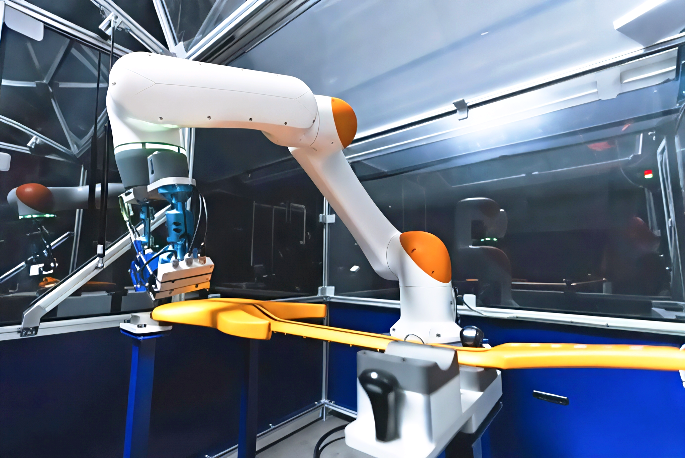
Industrial Machinery
Structural Brackets, Pump Housings, High-Load Gears, Conveyor Systems, robotic arm base.

Sporting Goods
Bicycle Frames, Ski Bindings, Firearm Stocks, High-Performance Equipment.
Design & Processing Excellence
Q: Critical Moisture Management
A: Pre-Drying is Mandatory. Dry pellets for 3–4 hours at 80-90°C (176-194°F) to reduce moisture content below 0.1%. Proper drying is essential to prevent hydrolysis during molding and ensure optimal mechanical properties.
Q: Recommended Injection Molding Parameters
A: Use a general-purpose screw with low shear. Melt temperatures should be in the 260-280°C (500-536°F) range. A high mold temperature of 80-120°C (176-248°F) is crucial for achieving a high-quality surface finish and optimal crystallinity.
Q: Design for Long Fiber Composites
A: Utilize generous radii and uniform wall thicknesses. Gate locations should be chosen to promote fiber alignment in the direction of principal stress. Be aware of anisotropic shrinkage; consult our full design guide or technical team for support.
Frequently Asked Questions
Q: What is the difference between LFT-G® PA6 GF30 and standard short-fiber PA6 GF30?
A: The primary difference is the fiber length. The long glass fibers in LFT-G® form an internal, interlocking skeletal network within the part. This structure is vastly superior at dissipating energy and transferring stress, resulting in significantly higher impact strength, creep resistance, and dimensional stability compared to the disconnected short fibers in standard PA6 GF30.
Q: How does moisture absorption affect final part performance?
A: Moisture acts as a plasticizer in PA6. As a part absorbs ambient moisture (conditions), it will become more ductile and tougher (higher impact strength) but will see a reduction in stiffness and strength, as shown in our TDS. This behavior is predictable and must be accounted for in the design phase. We provide both DAM and Conditioned data for accurate FEA simulations.
Take the Leap from Metal to Composite
Our team is ready to help you unlock the potential of lightweighting with LFT-G® composites. Contact us today for a comprehensive technical consultation, simulation support, or a prototype for your next project.
Hot Tags: pa6 gf30 composite long fiber, China, manufacturers, suppliers, factory, buy, customized


