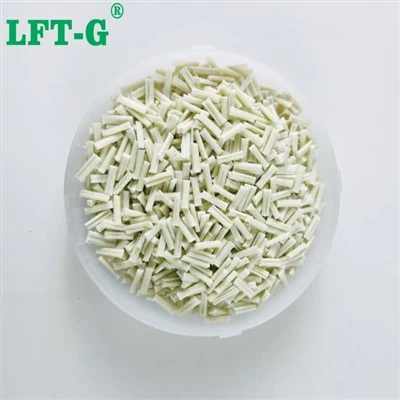
LFT-G® ABS LGF30 is a 30% long glass fiber-reinforced ABS compound that delivers outstanding rigidity, impact strength, and cosmetic surface quality for structural and consumer applications. ✓ Balanced stiffness & impact toughness ✓ Cosmetic-grade molded surface ✓ Excellent dimensional stability & low warpage ✓ Lightweight alternative to metal and short-fiber grades
A Long-Glass ABS Built for Visible Structural Parts
LFT-G® ABS LGF30 is a 30% long glass fiber reinforced ABS composite developed for applications that combine structural rigidity, impact toughness, and a premium molded surface. It sits in a unique position between commodity ABS and engineering plastics - delivering the stiffness of a reinforced material while keeping the processability and appearance that make ABS the benchmark for visible components.
The 3D long-fiber skeleton inside the part dramatically improves load-bearing capacity, creep resistance, and dimensional accuracy over short-glass grades. Meanwhile, the ABS matrix preserves low-temperature impact strength, excellent flow, and compatibility with painting, plating, and printing - making ABS LGF30 a practical drop-in upgrade for structural housings, interior trim, and precision enclosures.
Target sectors include automotive interior components, consumer electronics frames, home appliance structural parts, and industrial equipment covers.
ResinABS
Fiber30% long glass
ColorBlack / Natural
HDT105 °C
Flammability HB @ 1.5 mm
Why Engineers Choose ABS LGF30
01 - STIFFNESS
Long glass fibers raise flexural modulus to ~6,000 MPa, delivering the rigidity needed for thin-wall structural parts.
02 - TOUGHNESS
ABS matrix preserves impact strength even at low temperatures, reducing cracking risk in drop and vibration scenarios.
03 - APPEARANCE
Optimized dispersion minimizes fiber bloom, producing smooth surfaces ready for paint, plating, or direct use.
04 - STABILITY
3D fiber network reduces shrinkage and warpage, holding tight tolerances for precision assembly.
05 - DURABILITY
Continuous fibers resist creep and fatigue, maintaining part geometry under sustained and cyclic loads.
06 - PROCESSING
Good melt flow on standard injection machines enables complex ribs and thin sections without special equipment.
Technical Data Sheet
Property
Typical Range
Method
Density
1.20 g/cm³
ASTM D-79
Molding Shrinkage (Flow)
0.10 – 0.20 %
ASTM D-955
Tensile Strength (Yield / Break)
65 – 100 MPa
ISO 527
Tensile Modulus
5,300 – 8,960 MPa
ISO 527
Tensile Elongation (Break)
1.5 – 4.4 %
ISO 527
Flexural Strength
98 – 165 MPa
ISO 178
Flexural Modulus
4,930 – 8,500 MPa
ISO 178
Notched Izod Impact (23°C)
53 – 64 J/m
ISO 180
Notched Charpy Impact (23°C)
7 – 9 kJ/m²
ISO 179
HDT @ 1.8 MPa
96 – 105 °C
ISO 75-2
Typical ranges compiled from commercial datasheets for 30% glass fiber reinforced ABS (short/chopped fiber).
Processing Window
PRE-DRYING
2–4 hrs @ 80–90 °C
Desiccant dryer
MELT TEMP
220–250 °C
Barrel measured
MOLD TEMP
45–75 °C
Higher for gloss
INJECTION
60–120 MPa
Free-flow valve
Tip: Use metering screw 18:1–24:1 L/D, 40% feed, large open nozzle. Purge with PE or PP before shutdown.
Where ABS LGF30 Performs
Instrument Panels & Door Trim
Substrates, brackets, and console structures use ABS LGF30 for its low-emission formulation, dimensional stability, and surface quality that supports direct painting or wrapping.
Frames, Housings & Back Covers
Laptop frames, TV backs, and smart device housings benefit from the material's high rigidity-to-weight ratio and cosmetic finish that reduces metal inserts and post-processing.
Structural & Functional Parts
Washing machine components, fan blades, and vacuum housings rely on ABS LGF30 for its resistance to vibration, chemicals, and long-term thermal cycling.
Covers, Housings & Tool Casings
Power tool casings, electronic enclosures, and control cabinets use ABS LGF30 for its impact toughness and compatibility with painting, plating, and printing.
Frequently Asked Questions
Q: How is ABS LGF30 different from standard ABS GF30?
Long glass fibers remain continuous within the pellet, forming a 3D network that delivers roughly 60% higher tensile modulus than short-glass ABS GF30, plus better creep resistance and dimensional stability - while preserving ABS's signature surface quality and impact toughness.
Q: Can ABS LGF30 be used for visible cosmetic parts?
Yes. Optimized fiber dispersion keeps surface fiber bloom minimal, so parts come out of the mold with a smooth finish ready for direct use, painting, electroplating, or silk-screening.
Q: What are the most important processing controls?
Pre-dry below 0.05% moisture, keep melt temperature between 220–250 °C, use mold temperature 45–75 °C for surface quality, and minimize residence time. A low-compression screw and generous gating preserve fiber length.