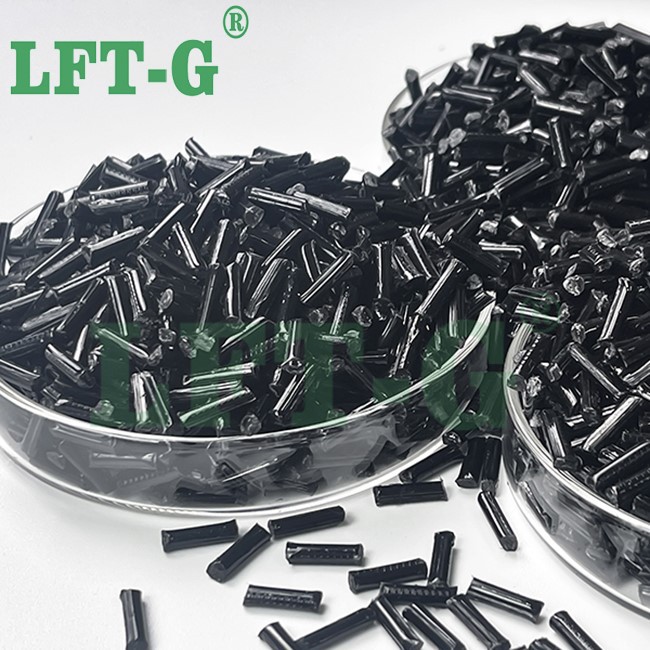


LFT-G® PA6 LCF30 | 30% Long Carbon Fiber Reinforced PA6 (Nylon 6)
High-Specific-Stiffness Metal Replacement | Low Warpage | Conductive-Ready Long Carbon Fiber Nylon

LFT-G® PA6 LCF30 is a 30% long carbon fiber reinforced nylon 6 compound developed for injection-molded parts that must carry real structural load without giving up toughness or dimensional accuracy. The continuous carbon fiber bundles run the full length of each pellet, so the finished part keeps a longer effective fiber length than short-fiber compounds-the key reason its stiffness, fatigue resistance and creep behavior stay predictable in service.
Beyond mechanical performance, carbon fiber brings a design bonus that glass fiber cannot: an electrically and thermally conductive network inside the PA6 matrix. That opens the door to static-dissipative parts, EMI-shielding housings and heat-spreading structural components without adding a separate conductive coating. With excellent oil and fuel resistance inherited from nylon 6, very low molding shrinkage and strong resistance to sustained vibration, PA6 LCF30 is a practical lightweight replacement for die-cast aluminum, magnesium and short-carbon-fiber PA6 in automotive brackets, power-tool drivetrain parts, robotic arms, drone airframes, high-voltage connector bodies and industrial gears.
Key Material Strengths
- Metal-Level Stiffness at Plastic Weight
Tensile and flexural modulus reach levels normally associated with light metal castings, while density stays close to unfilled nylon-so brackets and arms lose weight without losing rigidity.
- Conductive and Thermally Dissipative
The carbon fiber network provides a path for static charge and heat, supporting static-dissipative parts, EMI shielding designs and heat-spreading structural housings in a single molded component.
- Minimal Shrinkage and Low Warpage
Very low molding shrinkage and a long-fiber skeleton keep flat parts flat and hole positions repeatable, which shortens mold trials and reduces assembly rework on multi-cavity tools.
- Fatigue and Creep Resistance
Long fibers bridge micro-cracks and carry load across ribs and bosses, so parts hold preload and geometry through vibration, cycling and long-term static stress.
- Oil, Fuel and Heat Resistance from PA6
The nylon 6 matrix resists lubricating oils, greases and many automotive fluids, with a heat deflection temperature high enough for under-hood and power-tool duty.
Test Data Comparison
Typical Properties
| Property | Typical Value | Standard |
|---|---|---|
| Specific Gravity | 1.24 g/cm³ | ASTM D-792 |
| Molding Shrinkage | 0.10 – 0.20 % | ASTM D-955 |
| Tensile Strength | 236 MPa | ISO 527 |
| Tensile Modulus | 22,963 MPa | ISO 527 |
| Tensile Elongation | 0.8 – 1.5 % | ISO 527 |
| Flexural Strength | 336 MPa | GB/T 9341 |
| Flexural Modulus | 14,845 MPa | GB/T 9341 |
| Notched Izod Impact | 38 kJ/m² / 366 J/m | ISO 180 / ASTM D-256 |
| Notched Charpy Impact | 36 kJ/m² | ISO 179 |
| HDT (1.8 MPa) | 208 °C | ISO 75-2 |
| Flame Retardant | HB @ 1.5 mm | ASTM D-635 |
Product Specification
| Item | Specification | Note |
|---|---|---|
| Product Grade | LFT-G® PA6-BC03A | Standard grade |
| Base Resin | PA6 (Nylon 6) | Injection grade |
| Fiber Type | Long Carbon Fiber | Continuous |
| Fiber Content | 30 % (by weight) | LCF30 |
| Color | Black | Custom colors on request |
| Pellet Form | Fiber-bundled pellets | Approx. 6 – 12 mm |
| Processing | Injection Molding | Extrusion on request |
| Packaging | 20 kg/bag | Foil moisture-barrier bag |
| MOQ | 500 kg (1 pallet) | Sample orders available |
| Storage | Cool, dry, sealed | 24 months unopened |
Long Carbon Fiber PA6 vs. Short Carbon Fiber PA6

The comparison above places LFT‑G® PA6 LCF30 against a conventional short carbon fiber PA6 at the same fiber loading. The focus is on what actually decides whether a molded structural part survives in the field: stiffness retention after long-term load, notched impact behavior, flatness across rib-to-wall transitions, creep under static compression, and fatigue life under repeated flexing.
In a short-fiber compound, fibers end abruptly and stress concentrates at those ends, which is where cracks start and where creep accelerates. The continuous bundles in PA6 LCF30 carry load across a much longer effective length, distributing stress more evenly into the nylon matrix. In practice, this means brackets hold their preload, gears keep their mesh, and long flat parts stay flat after months in service rather than drifting out of tolerance.
For engineers evaluating PA6 LCF30 against short carbon fiber PA6 for metal replacement, the long-fiber grade is the stronger candidate wherever creep, fatigue and dimensional repeatability drive the design. Typical target parts include automotive front-end brackets, seat and door module structures, power-tool gearbox housings, robotic arm segments, drone airframes, industrial gears and high-voltage connector bodies.
LFT-G® Injection Molding Manufacturing Process

| Parameter | Recommended Range | Key Notes for LFT-G® PA6 LCF30 |
|---|---|---|
| Pre-drying ① | 85 – 100 °C, 2 – 4 h | Use a dehumidifying dryer; bring moisture below 0.05% to avoid hydrolysis |
| Melt Temperature ② | 243 – 270 °C | Measured melt temperature in the barrel; check set-vs-actual deviation to prevent carbonization |
| Mold Temperature ③ | 54 – 95 °C | Refers to measured mold surface temperature; affects appearance and dimensional stability |
| Injection Pressure | 70 – 130 MPa | Profile the fill to avoid high shear at gates that shortens fiber length |
| Screw & Machine | L/D 18:1 – 24:1 | Wear-resistant screw and barrel, free-flow check valve, large open nozzle, 100 T+ machine |
Critical Tips:
Gating: Full round runners of 5–6 mm minimum, gate size at least about 5 mm; use large sprue and straight gate, avoid pin-point gates and abrupt restrictions
Recyclate: Keep regrind at or below about 3–5%; higher ratios shorten fiber length and reduce mechanical performance
Typical Engineering Applications

Automotive Structural Brackets & Battery Frames
Front-end module brackets, seat and door module structures, battery-pack cross members and underbody mounting frames. The long carbon fiber skeleton replaces stamped steel and die-cast aluminum with a single molded part that keeps its bolt-hole alignment through vibration, oil exposure and thermal cycling.

Power Tool Gearboxes & Industrial Gears
Gearbox housings, motor mounts, planetary carriers, worm gear blanks and cam-follower components. High stiffness plus nylon's natural lubricity keeps gear mesh tight under torque pulses, while long fibers resist tooth-root fatigue better than short-fiber compounds.

Drone Airframes & Robotic Arm Segments
Motor mounts, arm joints, gimbal brackets, payload frames and end-effector links. Every gram matters here, and PA6 LCF30 delivers metal-class bending stiffness at a fraction of the weight, with the damping and impact tolerance that carbon-fiber laminates often lack.

HV Connector Bodies & EMI Shielding Housings
High-voltage connector shells, inverter brackets, sensor housings and electronic control enclosures. The carbon fiber network provides a conductive path for static dissipation and shielding, so a single molded housing can replace a plastic part plus a separate metallized coating or metal shield.
FAQ
Q: What is LFT-G® PA6 LCF30?
A: A 30% long carbon fiber reinforced nylon 6 compound for injection molding. The continuous fiber bundles stay long inside the part, giving metal-class stiffness, low warpage and fatigue resistance, plus a conductive carbon network that glass fiber cannot offer.
Q: Where is PA6 LCF30 usually specified?
A: Automotive brackets and battery frames, power-tool gearbox housings, industrial gears, drone airframes, robotic arm segments, and HV connector or EMI housing bodies-anywhere metal is being replaced and both stiffness and flatness matter.
Q: How is PA6 LCF30 different from short carbon fiber PA6?
A: Long fibers carry stress across a much longer path, so creep, warpage and fatigue are noticeably better at the same fiber loading. Short-fiber grades are cheaper, but their properties drop faster in sustained-load and cycling applications.
Q: What should I prepare before molding PA6 LCF30?
A: Dry the pellets to below 0.05% moisture, use a wear-resistant low-compression screw, large full-round runners and generous gates, and keep regrind at or below 5%. Standard injection machines work, but wear protection is strongly recommended for carbon fiber.

Hot Tags: pa6 lcf30: advancing carbon fiber reinforced polymer design, China, manufacturers, suppliers, factory, buy, customized