
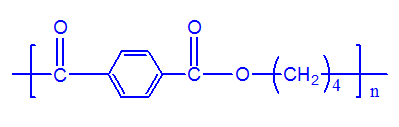
Molecular structure of PBT
The molecular structure of PBT is shown in the figure. It can be seen from the molecular structure that the PBT macromolecule is a linear structure with regular structure, and there are benzene rings and polar ester groups with difficulty in activity in the repeating structural unit, due to the benzene ring and the ester group. A conjugated system is formed to make the molecular rigidity larger, which reduces the flexibility, solubility and water absorption of the molecular chain. The presence of polar ester groups and carbonyl groups increases the intermolecular forces, making the molecules close together and the molecular chain rigid. At high temperatures, the ester group is susceptible to hydrolysis and cleavage, which affects the properties of the polymer. There are also 4 non-polar methylene-(CH2)- in the structural unit, which is 2 more than PET. The flexibility of the molecular chain is increased and the arrangement is more regular. Therefore, the crystallization ability of the material is higher than that of PET, and the crystallization rate is low. Fast and easy to shape.
The solubility parameter of PBT is 10.8 (J/cm3) 1/2, which is close to many plastics, so the range of blending is relatively wide. In addition, the molecular chain end of PBT contains a hydroxyl group or a carboxyl group, which is easily chemically reacted with an epoxy group, an acid anhydride, a carboxyl group or a hydroxyl group, and can be better mixed with a toughening agent containing these functional groups during blending, and a toughening agent. The adhesion of the interface is enhanced to achieve a better toughening effect.
PBT resin has excellent mechanical properties, good weather resistance, low hygroscopicity, good electrical insulation, and good optical transparency of amorphous polyester. However, PBT still has some shortcomings, and its notched impact strength is low. Low flame retardancy, low heat distortion temperature, poor dimensional stability at high temperatures, and anisotropy. Combined with the excellent performance of PBT, the modification of PBT has become an important means to expand the scope of PBT use.