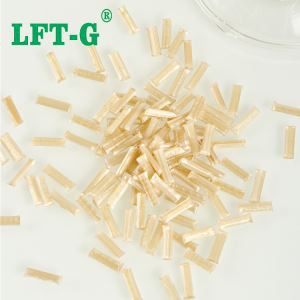

Why LFT-G® PA Series is Becoming the Go-To Material for Next-Gen Engine Compartment Components
The engine compartment is arguably the harshest environment for any plastic component. Temperatures fluctuate wildly, vibrations are constant, and exposure to oils, coolants, and road salts is relentless. For decades, short-glass-fiber-reinforced polyamide has been the industry standard. But that standard is shifting.

The Silent Revolution Under the Hood
A fundamental transition is underway in automotive engineering: long fiber polyamide (LFT-PA) is systematically replacing short-fiber PA in engine compartment applications. This isn't just about metal replacement anymore – it's about replacing short-fiber plastics that can no longer meet the demands of modern powertrains.
Why now? The answer lies in three converging trends:
- Thermal Intensification. Engine downsizing and turbocharging have pushed under-hood temperatures steadily upward. Short-fiber PA compounds, while cost-effective, struggle with thermal cycling fatigue – the repeated expansion and contraction that eventually causes fiber debonding, micro-cracking, and catastrophic failure.
- Extended Service Life Requirements. OEMs now demand components that survive 15+ years and 200,000+ miles without failure. Short-fiber materials, with their limited fiber length (typically < 1 mm), simply cannot provide the long-term creep resistance and fatigue endurance required.
- The "Invisible" Cost of Failure. A failed intake manifold or oil pan isn't just a warranty claim – it's a reputational hit. Engineers are increasingly choosing materials that offer predictable, long-term performance over those that merely meet minimum specifications.
-

Figure2:Modern engine compartments – high heat, constant vibration, chemical exposure
The LFT-G® PA Series: Engineered for the New Reality
LFT-G® offers a comprehensive PA portfolio designed specifically for next-generation engine compartment challenges. Our long fiber polyamide series delivers performance that short-fiber compounds simply cannot match.
LFT-G® PA6 LGF30: The Workhorse for High-Heat Structural Components
Model: LFT-PA6-GF30-NG03
This premium engineering composite features a tough Polyamide 6 matrix reinforced with 30% continuous long glass fiber. With a Heat Deflection Temperature (HDT) of 210°C, it perfectly replaces aluminum in engine covers, air intake manifolds, and radiator end tanks – delivering massive weight savings without thermal deformation.
| Property | LFT-G® PA6 LGF30 | Short-Fiber PA6 GF30 |
|---|---|---|
| Fiber Length | 10–12 mm | <1 mm |
| HDT (1.8 MPa) | 210°C | ~190°C |
| Fatigue Endurance | 2× longer | Baseline |
| Creep Resistance | Superior | Limited |
The long fiber skeleton (10–12 mm continuous fibers) creates an internal 3D mesh that boosts impact strength, doubles fatigue endurance, and minimizes long-term creep under load. Tensile strength exceeding 150 MPa routinely enables a 50% weight reduction compared with aluminum while eliminating costly secondary CNC machining.
Key applications:
- ✓Engine covers
- ✓Air intake manifolds
- ✓Radiator end tanks
- ✓Throttle bodies
-

Figure3:LFT-G® PA6 LGF30 engine cover – 50% weight reduction vs. aluminum
LFT-G® PA66 LGF40: Extreme Thermal Rigidity for the Most Demanding Environments
Model: LFT-PA66-LGF40-NG04
When the application demands the highest possible thermal and mechanical performance, LFT-G® PA66 LGF40 delivers. This natural grade composite reinforces a high-crystalline Polyamide 66 matrix with a 40% long glass fiber skeletal network.
With an HDT of 255°C at 1.8 MPa – far exceeding the 240°C short-term capability of standard grades – this material maintains dimensional stability even under the most extreme hood temperatures. Flexural modulus reaches 11,000 MPa, rivaling aluminum while offering significant weight reduction without sacrificing load-bearing capacity.
| Property | LFT-G® PA66 LGF40 | Short-Fiber PA66 GF40 |
|---|---|---|
| HDT (1.8 MPa) | 255°C | ~230°C |
| Flexural Modulus | 11,000 MPa | ~8,500 MPa |
| Warpage | Near-zero | Significant |
| Fatigue Endurance | 10⁷ cycles @ 70MPa | Premature failure under vibration |
The long fiber network reduces anisotropic shrinkage – a critical advantage for large, flat structural parts like oil pans that must stay flat and seal properly. The material resists crack initiation under high-frequency vibration where short-fiber PA66 GF40 would fail prematurely.
Beyond mechanical performance, LFT-G® PA66 LGF40 offers exceptional chemical stability, resisting ASTM #3 oil immersion with volume change below 3% after 1,000 hours.
Key applications:
- ✓Oil pans (flat, warp-free molding)
- ✓Engine mounts (vibration resistance)
- ✓Transmission brackets
- ✓Oil pump housings
-

Figure4:LFT-G® PA66 LGF40 oil pan – good flexural modulus, zero warpage
The Technical Edge: Why Long Fiber Makes the Difference
The performance gap between LFT-G® PA series and conventional short-fiber compounds comes down to fiber architecture.
In short-fiber compounds, glass fibers are typically < 1 mm in length. They provide initial reinforcement but offer limited resistance to:
- Creep – deformation under sustained load over time
- Fatigue – crack initiation and propagation under cyclic stress
- Thermal cycling – fiber-matrix debonding from repeated expansion/contraction
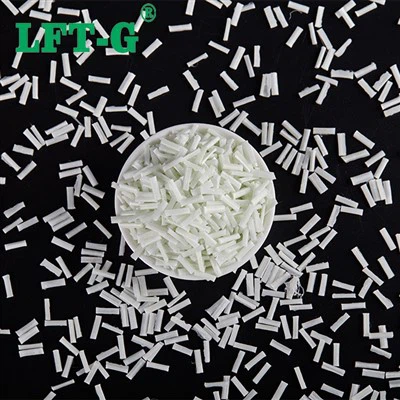
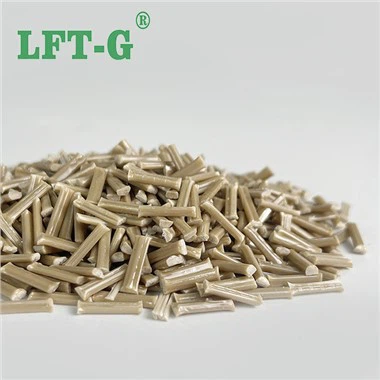
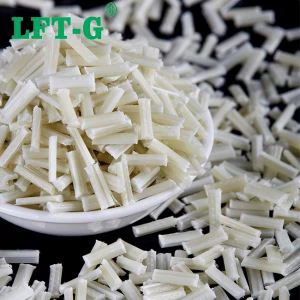
In the LFT-G® PA series, continuous glass fibers are preserved at 10–12mm length during compounding. These long fibers form a three-dimensional skeletal network within the polyamide matrix. This architecture delivers:
- Superior stress transfer – 89% efficiency versus conventional composites
- Crack arrest – long fibers bridge and arrest micro-cracks before they propagate
- Thermal stability – the fiber network maintains dimensional integrity through thermal cycling
- Fatigue endurance – 10⁷ cycles at 70MPa
Why LFT-G® for Your Next Program?
LFT-G® offers capabilities that set us apart in the long fiber polyamide space:
- Dual-Platform Flexibility. We offer both PA6 and PA66 base resins, allowing you to select the optimal balance of cost, thermal performance, and mechanical properties for your specific application.
- Multiple Glass Content Options. With 30% and 40% glass fiber loadings available, we provide solutions ranging from cost-effective structural components to extreme high-rigidity applications.
- Proven Manufacturing Excellence. Our proprietary pultrusion technology ensures optimal fiber wet-out and minimal fiber breakage during compounding.
- End-to-End Engineering Support. From material selection to mold design optimization, our engineering team helps you maximize the performance of LFT-G® PA series in your specific application.
- Global Quality Standards. LFT-G® products meet rigorous international specifications, including UL certification and ISO compliance.
The Bottom Line
The engine compartment is getting hotter, more crowded, and more demanding. Short-fiber polyamide – the workhorse of the past three decades – is reaching its limits. LFT-G® PA series represents the next generation: materials engineered not just to meet specifications today, but to deliver reliable performance for the life of the vehicle.
Whether you're designing an intake manifold that must survive 200,000 miles of thermal cycling, an oil pan that must seal perfectly for 15 years, or an engine cover that combines aesthetics with structural integrity – LFT-G® PA series has a solution engineered for your success.
Xiamen LFT Composite Plastic Co., Ltd. is a global supplier of long-fiber-reinforced thermoplastics with 20+ years of innovation. We specialize in LFT‑PP, LFT‑PA, LFT‑PPS, and LFT‑Elastomers – offering high‑strength, lightweight alternatives to metal for automotive, aerospace, and industrial applications.