
Post-Molding Shrinkage of Injection-Molded Parts: Causes and Control Methods
Post-molding shrinkage is a common issue in injection molding, where a molded part continues to decrease in size after demolding. This phenomenon can affect dimensional accuracy, assembly tolerances, surface quality, and long-term dimensional stability.
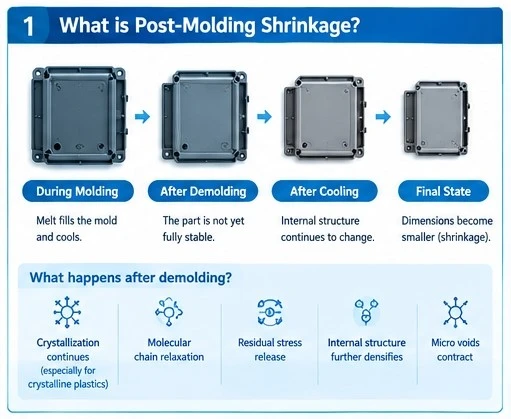
The dimensional change does not necessarily end when the part is ejected from the mold. After demolding, the material may continue to undergo crystallization, molecular-chain relaxation, residual-stress release, and further structural densification, resulting in additional dimensional shrinkage.
Therefore, controlling post-molding shrinkage requires more than simply extending the cooling time. A reliable solution should consider the material, molding process, mold design, part design, and post-processing conditions as an integrated system.
What Is Post-Molding Shrinkage?
During injection molding, polymer melt is injected into the mold cavity and then undergoes filling, packing, cooling, and solidification.
However, when the part is demolded, its internal structure may not yet be completely stable.
As the part continues to cool to room temperature, or during subsequent storage and service, several structural changes may occur:
- Molecular chains gradually relax.
- Residual stresses are released.
- Crystalline polymers continue to crystallize.
- Molecular orientation gradually recovers.
- Internal microvoids may contract further.
- The polymer matrix continues to undergo volumetric shrinkage.
These changes can cause the part to continue shrinking after demolding, which is commonly referred to as post-molding shrinkage.
In other words, dimensional stability is not determined only inside the mold. It is a continuous process that extends from melt processing to cooling and the post-demolding stage.
Why Does Post-Molding Shrinkage Occur?
Post-molding shrinkage is mainly related to material characteristics, molding conditions, and part structure. After demolding, the material may continue to undergo crystallization, molecular relaxation, residual-stress release, and further volumetric contraction.
Material Characteristics
Semi-crystalline thermoplastics such as PP, PE, PA, PBT, and PET generally show more noticeable post-molding shrinkage because crystallization may continue after demolding.
Amorphous polymers such as PC, ABS, PMMA, and PS do not undergo significant crystallization. Their dimensional changes are mainly associated with thermal contraction, molecular orientation, and residual-stress relaxation.
Material selection therefore has a direct influence on dimensional stability.
Molding Conditions
Insufficient holding pressure or holding time can result in inadequate packing, leaving the part more susceptible to further shrinkage after demolding.
Mold temperature, barrel temperature, plasticization, and cooling conditions also influence crystallization, molecular orientation, and residual stress. Improper settings can increase dimensional changes or create uneven shrinkage.
The key is to establish a stable molding window that provides sufficient packing, uniform cooling, and consistent melt plasticization.
Mold and Part Structure
Gate size and location determine how effectively holding pressure can compensate for material shrinkage. If the gate freezes too early, packing becomes ineffective.
Uneven cooling can create temperature differences across the part, leading to different shrinkage rates and eventually warpage.
Part geometry is equally important. Uneven wall thickness and excessively thick sections can cause differences in cooling, crystallization, and internal shrinkage, making dimensional stability more difficult to control.
How Can Mold Design Affect Post-Molding Shrinkage?
Gate Size and Location
The gate is an important pathway through which holding pressure is transmitted into the cavity.
If the gate is too small or improperly positioned, it may freeze before sufficient packing has taken place.
Once the gate freezes, additional holding pressure can no longer effectively compensate for material shrinkage inside the cavity.
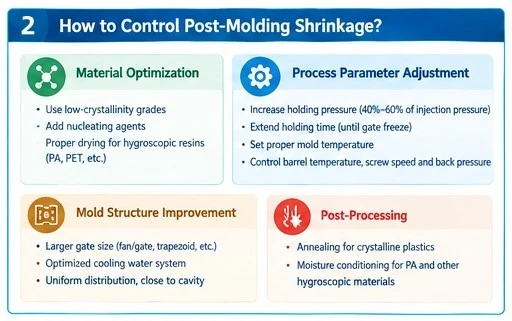
For parts prone to post-molding shrinkage, gate design can therefore be optimized by increasing the gate cross-section or using suitable gate geometries, such as fan gates or trapezoidal gates, to extend the effective packing period.
Uneven Cooling
The cooling system is another critical factor affecting dimensional stability.
If different regions of the mold cool at significantly different rates, temperature differences will translate into different shrinkage rates.
The basic relationship can be understood as:
Temperature Difference → Shrinkage Difference → Dimensional Difference → Warpage
This is particularly important for large structural parts, thick-to-thin transitions, and complex ribbed areas.
A properly designed cooling system should keep cooling channels reasonably close to the cavity surface and distribute them as uniformly as possible to minimize temperature differences across the part.
Material Selection as a Key Approach to Reduce Shrinkage
Process optimization is important, but material selection can also have a fundamental influence on dimensional stability.
In conventional unfilled polymers, dimensional changes are largely determined by the thermal contraction and structural relaxation of the polymer matrix.
When glass fibers or carbon fibers are incorporated into the polymer matrix, the shrinkage behavior changes.
How Do Long Fibers Help Reduce Shrinkage?
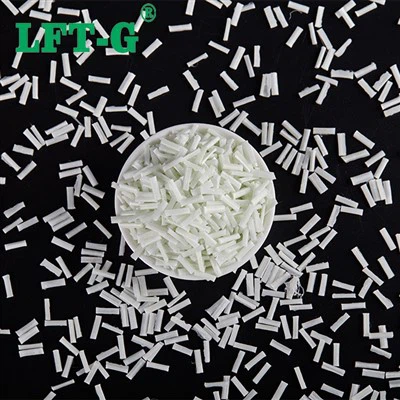
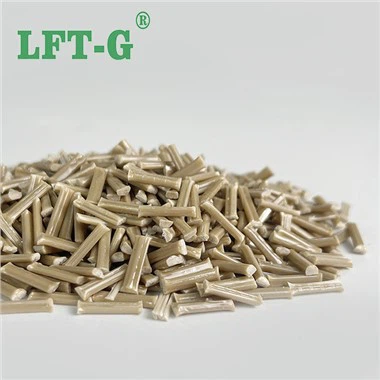
LFT-G® long-fiber-reinforced thermoplastics use relatively long glass fibers or carbon fibers as a reinforcing framework within the polymer matrix.
During injection molding, the fibers are distributed throughout the polymer and form an effective reinforcing network.
As the polymer matrix cools and tends to contract, the fiber framework provides a degree of mechanical constraint against matrix shrinkage.
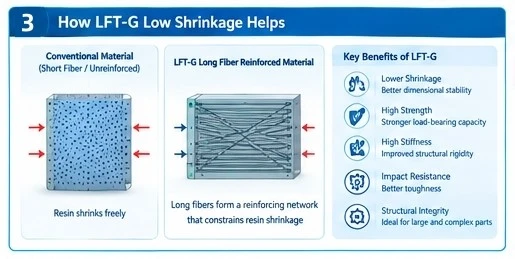
The mechanism can be simplified as follows:
Conventional Polymer
Polymer cooling → Molecular spacing decreases → Volumetric shrinkage
Long-Fiber-Reinforced Polymer
Polymer cooling → Matrix tends to shrink → Long-fiber network constrains the matrix → Overall dimensional change is reduced
As a result, long-fiber-reinforced thermoplastics can generally provide lower molding shrinkage and improved dimensional stability compared with unreinforced polymers.
This characteristic makes LFT materials suitable for large injection-molded structural components where dimensional stability, stiffness, and mechanical performance are important.
The Low-Shrinkage Advantage of LFT-G® Long-Fiber Materials
LFT-G® long-glass-fiber and long-carbon-fiber reinforced thermoplastics are designed not only for mechanical reinforcement but also for improved dimensional stability and structural integrity.
For large molded components, thin-wall structures, and complex geometries, conventional materials may experience dimensional changes caused by the combined effects of polymer shrinkage, fiber orientation, and fiber-length distribution.
Long-fiber reinforcement helps maintain a more effective reinforcing structure within the molded part.
The resulting material platform can provide several key advantages:
- Lower Shrinkage - Helps reduce overall molding shrinkage.
- Dimensional Stability - Supports more stable dimensions over time.
- High Stiffness - Improves structural rigidity.
- High Strength - Enhances load-bearing capability.
- Impact Resistance - Improves resistance to impact loading.
- Structural Integrity - Supports the stability of large and complex components.
For automotive, industrial equipment, new energy, robotics, and other applications involving large plastic structural components, dimensional stability can be an important factor in achieving reliable assembly and long-term performance.
Selecting a suitable material can reduce matrix-driven shrinkage. Optimized molding parameters can provide sufficient packing and stable plasticization. Proper mold cooling can minimize temperature differences, while balanced part geometry can reduce localized shrinkage.