

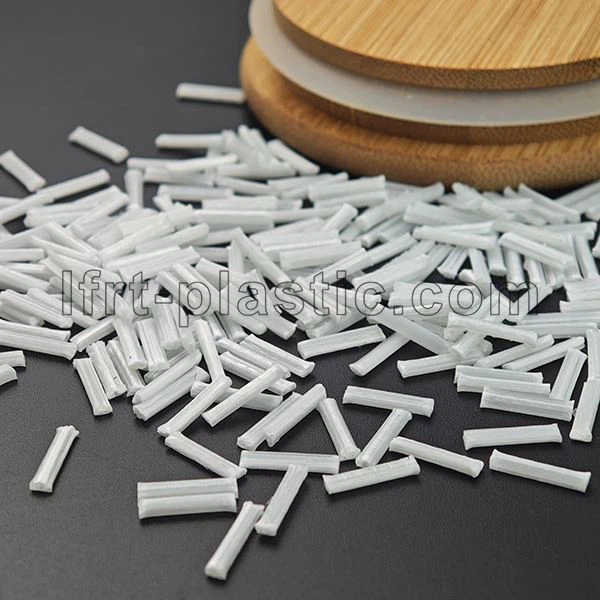
30% Long Glass Fiber TPU Material
In the rapidly evolving field of engineering materials, engineers and designers are constantly seeking solutions that offer higher performance, greater light weighting, and greater cost-effectiveness. Among the numerous innovative materials, long glass fiber thermoplastic polyurethane (LGF TPU) is standing out as a remarkable high-performance composite material. It ingeniously combines the flexibility and durability of thermoplastic polyurethane (TPU) with the outstanding reinforcing effect of long glass fibers, bringing revolutionary breakthroughs to multiple industries.
The core advantages of LGF TPU: Why is it so special?
To understand the uniqueness of LGF TPU material, one must first understand its internal structure. Unlike common short glass fiber reinforced plastics, the glass fibers in LGF TPU material have the same length as the polymer particles, typically ranging from 5 to 25 millimeters. During the injection molding process, these long fibers are not completely broken down, but instead form a three-dimensional framework network that interweaves throughout the entire part.
It is this unique internal structure that gives LGF TPU plastic pellet far superior performance compared to traditional materials:
Outstanding mechanical strength and stiffness: The long fiber framework can efficiently transfer stress from one area to another, which significantly enhances the tensile strength, bending strength and modulus of the material. The parts are less likely to deform or break when subjected to high loads.
Outstanding impact resistance: The long fiber network acts like an "energy absorber". When subjected to impact, it can effectively absorb and disperse the impact energy, thereby significantly enhancing the material's impact resistance. Even in low-temperature environments, it can maintain excellent toughness.
Excellent dimensional stability and low warpage: Due to the long fiber framework effectively restricting the contraction and flow of the polymer, LGF TPU molded parts have higher dimensional accuracy and lower warpage, making them particularly suitable for manufacturing large parts that require high precision mating.
Outstanding anti-rust and fatigue resistance properties: Under long-term constant load or repeated stress conditions, the long fiber network can effectively prevent the material from permanent deformation, making it highly suitable for use in structural components subjected to dynamic stress.
Widely Applied: The Unlimited Potential of LGF TPU Composite
The unique performance combination of LGF TPU material makes it an ideal alternative to many traditional materials (such as metals and engineering plastics). Its application scope is expanding rapidly, especially in fields that require high strength, lightweight, and excellent impact resistance:

Automotive industry: It can be used to manufacture front modules of cars, instrument panel frames, seat components, body floor guard plates, and battery pack shells.
The light weighting of these components helps improve fuel efficiency and range, while high strength ensures collision safety.
Industrial and mechanical fields: LGF TPU material can be used to manufacture the casings of power tools, industrial casters, pump bodies, valves and various mechanical components.
Its high strength and wear resistance ensure the long-term reliability of the products under harsh working conditions.
Sports and leisure products: In bicycle components (such as pedals and handlebars), ski bindings, and other high-performance sports equipment.
LGF TPU offers a perfect combination of strength and toughness, making the products both sturdy and lightweight yet flexible.
Electronic devices: Due to its excellent shock resistance and design flexibility, LGF TPU compound resin is also used to manufacture sturdy and durable shells for electronic devices, such as handheld terminals and tablet computer stands.
Manufacturing process: How to integrate TPU Pellet?
The production of LGF TPU is a precise process, typically carried out using the melt impregnation method. During this process, continuous glass fiber bundles are completely immersed in the molten TPU resin, ensuring that each fiber is fully integrated with the polymer matrix to form a uniform composite filament. Subsequently, these filaments are cut into fixed-length particles, which are the LGF TPU particles that we see.
In the manufacturing process of the final product, injection molding is the most commonly used method. To maximize the retention of the integrity of the long fibers, the injection molding process parameters need to be optimized, such as:
Reduce the rotational speed of the screw: To prevent excessive shear force from causing fiber breakage.
Optimize the flow channel design: Use large-diameter flow channels and gates to reduce the resistance of melt flow.
Precisely control the temperature: Ensure the material melts uniformly while avoiding excessive heating that could cause degradation.
These meticulous process controls are the key to ensuring that the final product achieves the best performance.
With the deepening of the concept of sustainable development, LGF TPU is also moving towards a more environmentally friendly direction, such as using bio-based TPU and recyclable glass fibers. At the same time, by adding other functional fillers, the performance boundaries of LGF TPU are still continuously expanding, and it is expected to find new applications in more high-tech fields. In summary, long glass fiber thermoplastic polyurethane is a promising composite material. With its unique structural advantages, it successfully combines flexibility with structural rigidity. In the future, it will bring us more innovative and efficient engineering solutions.

FAQ
Q: In which fields is LGF TPU mainly used?
A: It is widely used in the automotive industry (front-end modules, seat frames), industrial fields (electric tool casings), and sports and leisure products (bicycle components), mainly as a lightweight alternative to traditional engineering plastics.
Q: What are the special precautions to take during injection molding?
A: The key to injection molding LGF TPU composite is to protect the long fibers from being cut. The screw speed should be adjusted and an appropriate flow channel and gate should be designed to reduce the shear force and ensure the performance of the final product.
Q: How does LGF TPU compare to LCF TPU Material?
A: LGF TPU material usually has a lower cost and better impact resistance. While LCF TPU plastic pellet is more advantageous in applications that require extreme light weighting and stiffness. LGF TPU polymer offers a balance between strength and toughness.
For this type of material, LFT-G® has been deeply involved in this industry for many years and has accumulated certain market experience. If you are interested in this kind of material, you can contact our material experts for more detailed information. Click below,
Hot Tags: glass fiber tpu material, China, manufacturers, suppliers, factory, buy, customized


