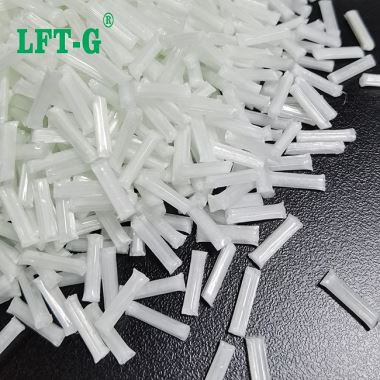


LFT PP LGF60 Copolymer: The Unbreakable PP GF60
When engineers search for "PP GF60," they seek the absolute limit of strength. But true strength isn't just stiffness-it's the ability to withstand real-world abuse. LFT-G® PP LGF60-NG06C is the ultimate evolution. It is a unique composite fusing a massive 60% long glass fiber load with a high-toughness copolymer polypropylene matrix.
This material achieves what was once thought impossible: the rigidity of die-cast metal combined with the fracture resistance of a high-performance polymer, even in arctic conditions. It is engineered for the most brutal environments, from heavy-duty mining equipment components to military hardware, where both extreme stiffness and impact survival are non-negotiable.
Flexural Modulus
Impact Resistance
Lighter than Steel
Navigating the Performance Matrix: Finding the "No-Compromise" Zone
Most materials force a choice between stiffness and toughness. LFT-G® PP LGF60 Copolymer creates a new category, occupying the top-right quadrant where both properties excel.
(Low Stiffness, Low Toughness)
(Low Stiffness, High Toughness)
(High Stiffness, Low Toughness)
(High Stiffness & High Toughness)
Technical Data Sheet: LFT-G® PP LGF60-NG06C
Typical values for our ultimate stiffness & toughness copolymer grade. Data is for reference only.
| Property | Test Method | Units | Typical Value |
|---|---|---|---|
| Long Glass Fiber Content | ASTM D5630 | % by weight | 60 |
| Density | ASTM D792 | g/cm³ | 1.48 |
| Tensile Strength | ASTM D638 | MPa | 160 |
| Flexural Modulus | ASTM D790 | GPa | 12.0 |
| Notched Izod Impact Strength (@ -40°C) | ASTM D256 | kJ/m² | 49 |
| Heat Deflection Temperature (@1.82 MPa) | ASTM D648 | °C | 162 |
Case Study: Off-Road Mining Vehicle Battery Enclosure

1. The Problem: Failing Steel Enclosures
A manufacturer of electric mining vehicles was using heavy welded steel enclosures to protect their battery packs. These enclosures were extremely heavy, reducing vehicle efficiency, and were failing prematurely due to constant, high-frequency vibrations causing weld fatigue and corrosion from acidic mine water.
2. The Solution: LFT-G® Implementation
LFT-G® PP LGF60C was selected. Its extreme stiffness was necessary to provide structural protection for the battery cells, while its copolymer base offered superior vibration damping and impact resistance from rock strikes. A single-piece, rib-reinforced design was developed, eliminating welds and leveraging the material's total corrosion immunity.
3. The Outcome: Unprecedented Durability
The LFT enclosure was 65% lighter, significantly improving vehicle battery life and payload capacity. After 2 years in the field, there were zero reported failures due to vibration or corrosion. The material's durability in extreme conditions (tested from -40°C to +80°C) established a new benchmark for reliability and led to a 75% reduction in warranty-related costs for the component.
Applications Where Failure is Not an Option

ATV Suspension Arms
Replaces forged aluminum. It offers the extreme stiffness to maintain suspension geometry under heavy loads and the impact resistance to survive rock strikes and hard landings without catastrophic failure.

Heavy-Duty Industrial Gears
For low-speed, high-torque applications where metal gears are noisy and require lubrication. The LFT material offers excellent wear resistance, self-lubrication, and noise damping properties.

Wind Turbine Hubs
For small to medium turbines, this material can replace cast metal hubs. It must withstand enormous fatigue stresses and extreme weather for decades, making the stiffness and durability of LFT-G® PP LGF60C ideal.
Key Questions Answered
1. What does "PP GF60" mean and how is LFT superior?
A: "PP GF60" is a general term for polypropylene with 60% glass fiber. However, it usually implies short fibers. Our LFT-G® PP LGF60 uses long fibers, which create a structural skeleton inside the plastic. This gives it vastly superior creep resistance, fatigue life, and impact strength compared to any short-fiber PP GF60, making it a true engineering-grade material.
2. What is the difference between this Copolymer (C) and the Homopolymer (H) LGF60 grade?
A: This Copolymer (NG06C) grade is engineered for maximum durability and impact resistance, especially in the cold, while maintaining near-metal stiffness. The Homopolymer (NG06H) grade pushes stiffness to its absolute maximum but at the expense of some toughness. If your part might be hit, dropped, or used in freezing weather, this 'C' grade is the safer, more reliable choice.
3. Is a material with 60% glass fiber difficult to process?
A: Due to its high viscosity, LFT PP LGF60 requires an experienced molder and a properly configured injection molding machine (e.g., with a low-compression screw). It is best suited for parts with wall thicknesses of 3mm or greater to ensure proper flow and fiber distribution. For highly complex or thin-walled parts, a lower fiber content like LGF40 or LGF50 might be more suitable.
Ready to Engineer the Next Breakthrough?
Elevate your product's performance with the proven strength and versatility of LFT-G® PP LGF60 Copolymer. Contact our material specialists today to discuss your project or request a material sample.
Hot Tags: pp lgf60-c: the unbreakable pp gf60, China, manufacturers, suppliers, factory, buy, customized