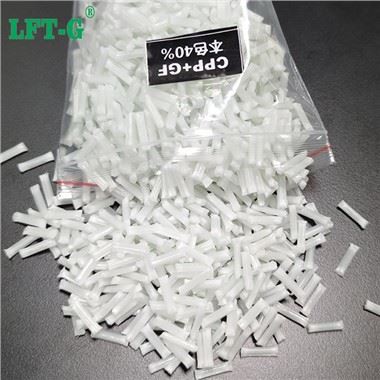

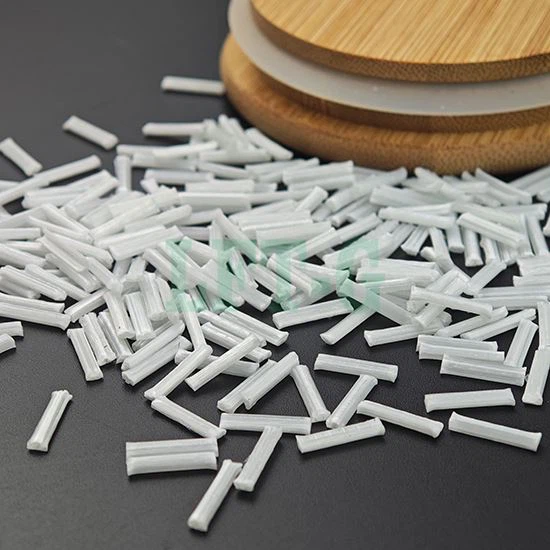
LFT-G® PP GF60 (Model: LFT-HPP-LGF60-NG06) is our highest-rigidity composite solution, featuring 60% long glass fiber reinforcement  embedded in a premium Homopolymer Polypropylene (H-PP) matrix. Engineered for the most demanding structural applications, this material bridges the performance gap between traditional thermoplastics and die-cast metals. By utilizing pultrusion technology, we ensure fibers retain their length within the pellet, creating a robust 3D skeletal network that delivers exceptional flexural modulus and creep resistance.
It is specifically formulated to replace heavier materials like aluminum, magnesium, and PA66 GF50 in automotive and industrial components, offering a weight reduction of up to 40% without compromising structural integrity.
Why Choose LFT-G® 60% LGF Homopolymer PP?
Not all "PP GF60" materials are created equal. Standard short fiber compounds at this loading level often suffer from brittleness and poor surface finish. LFT-G® leverages the synergy of Long Fibers and a Homopolymer Matrix to overcome these limitations.
- ● Maximum Rigidity (The Metal Replacement Choice): With a glass content of 60%, this grade achieves a Flexural Modulus exceeding 13,000 MPa. This stiffness allows engineers to design thinner walls while maintaining the part's ability to carry heavy static loads.
- ● Homopolymer Thermal Advantage: We use a high-crystallinity Homopolymer PP base rather than a Copolymer. This results in superior heat deflection temperatures (HDT) and surface hardness, making it ideal for under-the-hood automotive parts exposed to engine heat.
- ● Fatigue Endurance: The entangled long fiber network dissipates stress energy more efficiently than short fibers, allowing parts to withstand millions of vibration cycles without failure.
- ● Creep Resistance: Under continuous loading, LFT-HPP-LGF60-NG06 shows negligible deformation over thousands of hours, a critical property for structural frames and housings.
Technical Data Sheet: LFT-HPP-LGF60-NG06
| Properties | Test Method (ISO) | Typical Value | Unit |
|---|---|---|---|
| Glass Fiber Content | ISO 3451 | 60 | % |
| Density | ISO 1183 | 1.44 - 1.46 | g/cm³ |
| Tensile Strength | ISO 527 | 145 - 155 | MPa |
| Flexural Modulus | ISO 178 | 13,000 - 14,000 | MPa |
| Notched Impact Strength (23°C) | ISO 179 | 20 - 25 | kJ/m² |
| Heat Deflection Temp (1.80MPa) | ISO 75 | 158 - 162 | °C |
Download Complete LFT PP GF60 Data Sheet PDF
Primary Applications: High-Load Structural Components

Panoramic Sunroof Frames
Replacing aluminum rails. The 60% fiber content ensures the frame remains rigid over the entire roof span without warping under thermal expansion.

Industrial Fan Blades
For large HVAC systems. LFT-LGF60 reduces rotational mass compared to metal blades, improving energy efficiency while withstanding high centrifugal forces.

Structural Furniture Parts
Replaces die-cast aluminum in office chair bases and table supports. Provides the necessary weight-bearing capacity with a high-quality surface finish.
Processing High-Fiber Content (60%)
Molding a 60% glass filled material requires expertise. Unlike lower fiber content grades, LFT-HPP-LGF60-NG06 has a higher viscosity. To ensure optimal results:
- ● Temperature Control: Maintain mold temperatures between 50°C - 70°C to ensure a resin-rich surface and reduce floating fibers.
- ● Wear Protection: Due to the high glass content, we recommend using wear-resistant screws and barrels (bimetallic) to prolong equipment life.
- ● Drying: While PP is not hygroscopic, surface moisture on pellets can cause defects. Pre-drying at 80°C for 1-2 hours is recommended for Class A surface requirements.
People Also Ask (FAQ)
Q: Is PP GF60 brittle due to the high glass content?
A: Compared to lower fiber grades, yes, but LFT improves it. While 60% short fiber PP is extremely brittle, our LFT-G® Long Fiber technology maintains a fiber skeleton that significantly improves impact resistance. However, this grade is designed for stiffness, not extreme flexibility.
Q: Can LFT-PP LGF60 replace die-cast Magnesium?
A: Yes, it is a primary application. Magnesium alloys are light but expensive and require secondary processing. LFT-PP LGF60 offers comparable structural stiffness for many applications but with lower density, no corrosion issues, and the ability to injection mold complex geometries in one shot.
Q: What is the difference between Homo-PP and Copo-PP for LGF?
A: Homo-PP is stiffer and stronger. We use Homopolymer PP for our LGF60 grade because it has a higher crystalline structure than Copolymer. This maximizes the flexural modulus and tensile strength, which is the main goal when using 60% glass fiber reinforcement.
Pushing the Limits of Plastic?
When standard materials fail, LFT-G® LGF60 delivers. Contact us for mold flow support and pricing on our high-modulus series.

Hot Tags: pp gf60-long glass fiber polypropylene, China, manufacturers, suppliers, factory, buy, customized