

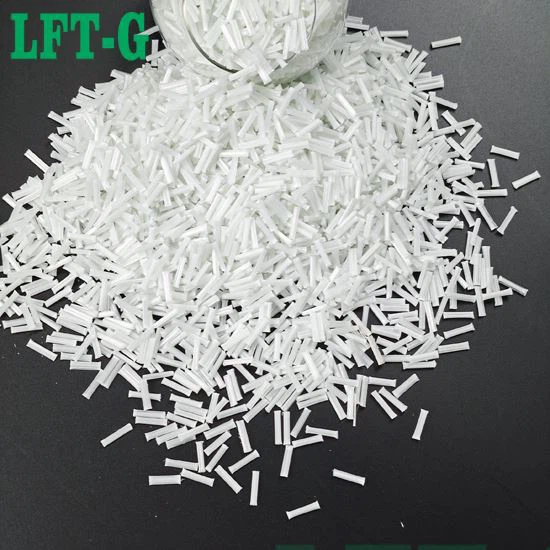
What is glass polypropylene
"Glass polypropylene," often denoted as PP-GF, refers to a category of thermoplastic composites where polypropylene (PP) resin – a versatile polymer valued for its low density, good chemical resistance, and ease of processing – is reinforced with glass fibers (GF). The incorporation of these glass fibers serves to significantly enhance the base polypropylene's mechanical properties, such as its strength, stiffness (modulus), and ability to withstand higher temperatures without deforming (heat deflection temperature). This reinforcement makes glass polypropylene suitable for a wider array of applications than unfilled PP, particularly where greater structural integrity is needed.
However, the term "glass polypropylene" is broad. A critical differentiator in performance lies in the length of the glass fibers and their concentration. LFT-G® PP LGF40 exemplifies an advanced iteration, signifying a Long Glass Fiber Polypropylene compounded with a substantial 40% fiber loading. Unlike Short Glass Fiber (SGF) polypropylene, where fibers are typically much shorter, the "Long Fiber" technology (LFT) in LFT-G® PP LGF40 ensures that the fibers maintain significant length (often 10mm or more, aligning with the pellet length) within the final molded part. These long fibers create a robust, interlocked 3D skeletal network within the PP matrix. This LFT structure is paramount for achieving superior impact strength, exceptional stiffness, and improved creep resistance, making LFT-G® PP LGF40 a high-performance material for demanding structural applications, offering a clear advantage over generic or short-fiber "glass polypropylene."

Core Advantages of PP GF40 Long Fiber Polypropylene
Long Glass Fiber Polypropylene, such as the PP GF40 long fiber grade referenced in the title and further exemplified with higher performance in grades like our LFT-G® PP LGF40, offers a distinct set of advantages over unfilled or short-fiber reinforced polypropylene:
-
Dramatically Increased Impact Strength
-
Superior Strength-to-Weight Ratio
-
Significantly Higher Stiffness and Rigidity
-
Enhanced Dimensional Stability & Lower Warpage
-
Improved Creep and Fatigue Resistance
-
Greater Design Freedom for Complex Parts
-
Better Performance Retention at Elevated Temperatures

Key Applications of LFT-G® PP LGF40 Long Fiber Compounds

Automotive Sector
LFT-G® PP LGF40 is extensively used in the automotive industry for manufacturing large, structural, and semi-structural components requiring high strength, stiffness, and impact resistance at a reduced weight. Applications include front-end modules, instrument panel carriers, door module structures, battery trays for EVs, underbody shields, spare wheel wells, and tailgate inner structures. Its excellent processability allows for complex designs and parts consolidation.
Home Appliance & Industrial Applications
In home appliances, LFT-G® PP LGF40 provides robust structural support for washing machine drums, dishwasher chassis components, and air conditioner fan blades/housings. For industrial applications, it's ideal for durable pump housings, gears, conveyor components, and power tool casings where high mechanical performance and resistance to wear or chemicals are critical. The material's good dimensional stability ensures longevity and reliable operation.
Frequently Asked Questions about PP LGF40
What makes LFT-G® PP LGF40 different from standard GF30 or other glass-filled PP?
+
-
LFT-G® PP LGF40 contains 40% *long* glass fibers, which form a more robust internal skeletal network compared to the shorter fibers in standard GF30 or SGF PP. This results in significantly higher impact strength, better stiffness, improved creep resistance, and enhanced dimensional stability, especially in larger parts. The "40" also indicates a higher fiber content than a "30" grade, generally leading to increased mechanical properties.
Is LFT-G® PP LGF40 suitable for metal replacement?
+
-
Yes, absolutely. Due to its high strength-to-weight ratio, excellent stiffness, and impact resistance, LFT-G® PP LGF40 is frequently used to replace metal components (like steel or die-cast aluminum) in automotive and industrial applications, offering significant weight savings, corrosion resistance, and greater design flexibility for part integration.
What are the primary processing considerations for LFT-G® PP LGF40?
+
-
LFT-G® PP LGF40 is typically processed via injection molding. Key considerations include using appropriately designed screws and nozzles to minimize fiber breakage, optimizing melt and mold temperatures (see technical data), and careful gate design to ensure proper fiber orientation and part filling, especially for large or complex components. While PP has low moisture absorption, drying pellets is good practice if they have been exposed to humidity.
Let's collaborate! Discover how LFT-G®'s advanced PP LGF40 long glass fiber polypropylene materials can bring unparalleled strength, durability, and lightweighting advantages to your next project. Our team of material experts is eager to understand your specific application challenges and provide tailored solutions with our high-performance LFT-G® PP LGF40. Reach out to us to discuss your requirements.
Our address
NO.55,Hongxi South Road,Xiamen,Fujian,China.
Phone Number
(0086)-1395009-5707
Candyhu@lfrtplastic.com

Hot Tags: fiber glass polypropylene, China, manufacturers, suppliers, factory, buy, customized


