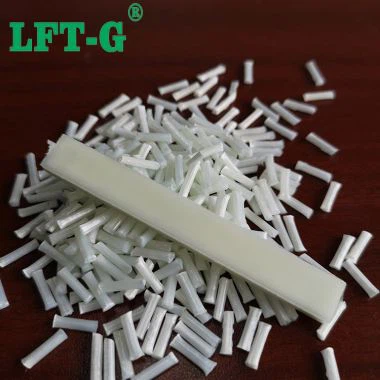


What is glass-filled nylon 6
"Glass-filled nylon 6" refers to a category of engineering thermoplastics where nylon 6 (Polyamide 6, or PA6) resin is compounded with glass fibers to significantly enhance its performance characteristics. Neat PA6 is valued for its good mechanical strength, toughness, wear resistance, and chemical resistance, particularly to oils and solvents. However, incorporating glass fibers, as in LFT-G® PA6 GF30, elevates these properties to a new level. Specifically, LFT-G® PA6 GF30 is a specialized grade featuring a Polyamide 6 matrix reinforced with 30% long glass fibers (LGF). The "long fiber" aspect is critical: these extended fibers form an internal, interconnected skeletal network within the molded part. This structure imparts substantially improved stiffness (flexural modulus), tensile strength, dimensional stability under load and temperature, and higher heat deflection temperatures compared to unreinforced PA6 or even short glass-filled nylon. This makes PA6 GF30, particularly the long glass fiber nylon 6 variant, an ideal material for replacing metals or lower-performing plastics in structurally demanding applications across automotive (like the representative radiator frames or structural components shown), industrial, and consumer goods sectors where a robust, heat-resistant, and dimensionally stable material is essential.

Core Advantages: Why is PA6 LGF30 and not the PA6 GF30?
The question "Why is PA6 LGF30 and not the PA6 GF30?" highlights a key technological advancement within glass fiber reinforced nylon materials. While "PA6 GF30" generally signifies Polyamide 6 with 30% glass fiber content, the "LGF" in LFT-G® PA6 LGF30 denotes "Long Glass Fiber." This distinction in fiber length is paramount, as it unlocks a significantly higher level of performance compared to conventional Short Glass Fiber (SGF) reinforced PA6 GF30. Both types leverage the inherent strengths of Polyamide 6-such as its good thermal stability, chemical resistance, and toughness-and the reinforcing power of glass fibers to boost mechanical properties. However, Long Fiber Technology (LFT), as employed in LFT-G® PA6 LGF30, creates a more robust internal fiber architecture, leading to distinct advantages in demanding applications. The table below outlines these key differentiators:
| Performance Aspect | Advantage of LFT-G® PA6 LGF30 (Long Fiber) |
| Impact Strength & Energy Absorption | The long, interlocked fiber network in PA6 LGF30 is significantly more effective at dissipating impact energy and resisting crack propagation, resulting in superior toughness and durability, especially at low temperatures. |
| Tensile and Flexural Strength | Longer fibers contribute to a more effective stress transfer from the PA6 matrix to the fibers, leading to higher overall tensile and flexural strength, particularly noticeable under high loads. |
| Creep Resistance & Fatigue Life | The robust 3D skeletal structure formed by long glass fibers in PA6 LGF30 offers substantially better resistance to deformation under sustained loads (creep) and improved endurance under cyclic stresses (fatigue). |
| Dimensional Stability & Warpage | PA6 LGF30 typically exhibits more isotropic shrinkage and lower overall warpage in complex molded parts compared to short fiber versions, ensuring higher precision and easier assembly. |
| Performance at Elevated Temperatures | Long glass fiber nylon 6, like PA6 LGF30, tends to retain its mechanical properties (strength and stiffness) more effectively at higher operating temperatures. |
| Weld Line Integrity | The longer fibers in PA6 LGF30 have a greater ability to bridge across weld lines during the molding process, resulting in significantly improved mechanical strength at these inherently weaker zones. |
| Design Freedom for Structural Parts | The enhanced mechanical profile allows for the design of thinner-walled yet robust structural components, enabling part consolidation and material savings with PA6 LGF30. |

- Industrial Equipment: Glass fiber reinforced nylon finds use in pump housings, valve bodies, gears, bearings, conveyor system components, and power tool housings, where PA6 GF30 offers robust mechanical performance, wear resistance, and dimensional stability under demanding operational conditions.
- Electrical and Electronics: Employed for connectors, circuit breaker housings, enclosures, and bobbins, leveraging the good dielectric properties of PA6 combined with the enhanced strength and flame retardancy (when specifically formulated) of glass-filled nylon grades.
What is glass-filled nylon used for?
Glass-filled nylon, particularly high-performance grades like LFT-G® PA6 GF30 (30% long glass fiber nylon 6), is utilized across a multitude of industries for components demanding a superior combination of mechanical strength, stiffness, thermal resistance, and durability. Its versatility makes it an ideal metal replacement material. Common applications include:
- Automotive Sector: Widely used for under-the-hood components such as engine covers, intake manifolds, air intake resonators, and cooling system parts (e.g., fan blades, shrouds, thermostat housings) due to PA6 GF30's excellent heat and chemical resistance. Also employed for structural parts like pedal boxes, seat adjustment mechanisms, mirror brackets, and front-end module carriers (as depicted in representative images), benefiting from its high strength and impact resistance.
- Consumer Goods & Sports Equipment: Used in durable goods like appliance components, furniture structural parts, ski bindings, and bicycle components,
LFT-G® PA6 LGF30 Technical Data Sheet
For High-Performance Engineering Applications
This document provides technical data for LFT-G® PA6 LGF30, a 30% Long Glass Fiber reinforced Polyamide 6 (Nylon 6) composite. This engineering thermoplastic offers an exceptional combination of high mechanical strength, stiffness, excellent thermal stability, good impact resistance (particularly due to the long fiber reinforcement), and favorable wear and chemical resistance characteristics. LFT-G® PA6 LGF30 is designed for demanding applications across various sectors, including automotive, industrial, and consumer goods, where it often serves as a lightweight alternative to metals.
Mechanical Properties
| Property | Typical Value Range | Unit | Test Standard |
|---|---|---|---|
| Tensile Strength | 160-190 | MPa | ISO 527-1/-2 |
| Tensile Modulus | 9000-12000 | MPa | ISO 527-1/-2 |
| Elongation at Break | 1.5-2.5 | % | ISO 527-1/-2 |
| Flexural Strength | 230-280 | MPa | ISO 178 |
| Flexural Modulus | 8500-11000 | MPa | ISO 178 |
| Notched Izod Impact Strength (+23°C) | 30-60 | kJ/m² | ISO 180/1A |
| Notched Izod Impact Strength (-30°C) | 20-40 | kJ/m² | ISO 180/1A |
Thermal Properties
| Property | Typical Value Range | Unit | Test Standard |
|---|---|---|---|
| Melting Temperature (DSC) | 220-225 | °C | ISO 11357-3 |
|
Heat Deflection Temperature (HDT/A, 1.8 MPa) |
199-210 | °C | ISO 75-2/A |
| Coefficient of Linear Thermal Expansion (CLTE, Flow, 23-80°C) | 2.0-3.5 | x 10-5/K | ISO 11359-2 |
Other Properties
| Property | Typical Value Range | Unit | Test Standard |
|---|---|---|---|
| Density | 1.36-1.38 | g/cm³ | ISO 1183 |
| Flammability (UL 94, 1.5mm) | V-2 / HB | - | UL 94 |
| Moisture Absorption (23°C, 24h immersion) | 0.7-1.0 | % | ISO 62 |
| Mold Shrinkage (Flow / Transverse) | 0.2-0.5 / 0.5-0.9 | % | ISO 294-4 |
| UV Resistance (Exterior Applications) | Good (Requires UV stabilization package) | - | ISO 4892 / SAE J2527 |
Chemical Resistance (Typical)
LFT-G® PA6 LGF30 exhibits good resistance to a range of chemicals, including:
- Hydrocarbons (e.g., oils, greases, fuels) - Excellent
- Aliphatic and Aromatic Solvents - Good
- Weak Bases - Good
- Automotive Coolants (Glycol-based) - Good (consider long-term exposure at high temp)
- Limited resistance to: Strong Acids, Strong Bases, Oxidizing Agents, Hot Water/Steam (hydrolysis).
Processing Information (Typical for Injection Molding)
Recommended conditions for LFT-G® PA6 LGF30. Drying is essential prior to processing.
- Drying: 4 hours at 80-90 °C (ensure moisture content <0.1%)
- Melt Temperature: 250-280 °C
- Mold Temperature: 80-120 °C (higher for improved surface finish)
- Injection Pressure: Medium to High (typically 60-100 MPa)
- Injection Speed: Medium to Fast (optimize for part fill and fiber integrity)
Notes and Supplementary Information:
Conditioning: Properties of Polyamide 6 are influenced by moisture content. Data presented is typically for dry-as-molded (DAM) conditions unless otherwise specified. Parts will absorb moisture from the atmosphere, leading to changes in properties (e.g., increased toughness and impact strength, decreased tensile strength and stiffness). This should be considered in design. Data Source: This data is compiled based on typical values for PA6 LGF30 from international material manufacturers and standards. LFT-G® PA6 LGF30 is engineered for applications requiring high mechanical load capacity, thermal endurance, and good durability. For specific project requirements or detailed long-term performance data (e.g., fatigue, creep at specific temperatures, detailed chemical exposure), please consult the specific LFT-G® material datasheet for your selected grade.
Download Complete LFT PA6 LGF30 Data Sheet PDF
Hot Tags: long glass fiber nylon 6 compoite, China, manufacturers, suppliers, factory, buy, customized