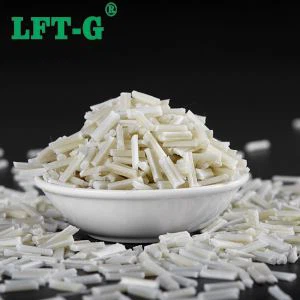


60% Long Glass Fiber PBT for Electrical & Structural Parts
|
|
LFT-G®PBT LGF60 is an ultra-high glass loading long fiber reinforced PBT compound engineered for electrical and structural parts that must hold precision under heat, humidity and sustained load. Pultruded pellets carry continuous glass fibers aligned along the pellet length; during molding, they open into a three-dimensional reinforcing network that delivers stiffness and creep resistance far beyond short-glass PBT at the same loading, while PBT's low moisture uptake keeps electrical and dimensional performance stable in service. PBT LGF60 compounds from LFT-G provide a reliable, cost-effective route to downsizing metal housings and short-glass engineering plastics, making them a strong fit for automotive electrical systems, new-energy vehicle components, industrial equipment and consumer electronics because they:
LFT-G® PBT LGF60 compounds are available in customized formulations to match specific electrical, thermal and color requirements. They are engineered for high-efficiency injection molding, reducing secondary machining and delivering consistent part quality with lower system cost. |

Typical Properties
| Property | Value | Unit | Test Standards |
|---|---|---|---|
| Density | 1.68 – 1.72 | g/cm³ |
ASTM D-792
|
| Tensile Strength | 195 – 210 | MPa | ISO 527 |
| Tensile Modulus | 15,500 – 16,800 | MPa | ISO 527 |
| Tensile Elongation | 1.0 – 1.8% | / | ISO 527 |
| Flexural Modulus | 14,500 – 15,300 | MPa |
ASTM D-790
|
| Flexural Strength | 295 – 310 | MPa | ASTM D-790 |
| Charpy Notched Impact | 28 – 33 | kJ/m² | ISO 179 |
| Heat Deflection Temp | 225 – 232 | °C |
ISO 75-2
|
| Glass Fiber Content | 60 | % | - |
LFT-G®-Technology Injection Molding Process
|
|
Our LFT-G® injection molding process uses a specialized screw and barrel design developed specifically for long-fiber reinforced thermoplastics. A gentle conveying geometry preserves fiber length during plasticization, so the continuous-fiber architecture from our pultruded pellets survives into the final part. This standardized process platform delivers globally consistent results with minimal lot-to-lot variation.
Low-shear processing prevents fiber breakage and enables uniform fiber distribution even at 60% glass loading, where short-fiber compounds typically show severe fiber attrition. Optimized melt temperature control and backpressure management protect the three-dimensional reinforcing network essential for stiffness and creep resistance. Modular screw designs adapt flexibly to different viscosities and part geometries-from thin-wall electrical housings to thick structural brackets. Benefits include stable cycle times, reduced warpage, fewer secondary operations, and lower overall system cost without compromising mechanical performance. |

Injection Molding Operating Guide

| Parameter | Recommended Range | Key Notes for PBT LGF60 |
| Drying Temperature ① | 100 – 120 °C | Use a dehumidifying dryer; PBT is hydrolysis-sensitive when wet |
| Drying Time ① | 2 – 4 hours | Bring moisture below 0.02% before processing |
| Melt Temperature (Nozzle) ③ | 260 – 290 °C | Avoid overheating to prevent matrix degradation and fiber damage |
| Mold Temperature ② | 80 – 120 °C | Higher mold temperature improves surface finish and dimensional stability |
| Injection Speed | Moderate to Fast | PBT crystallizes quickly; balance fill speed against fiber breakage |
Critical Tips:
Screw: Wear-resistant, low-compression screw; at 60% glass loading, barrel and screw wear protection is strongly recommended
Gating: Full-round runners Ø 5–6 mm with generous gates; avoid restrictive pin gates that shear and break long fibers
LFT-G® Key Applications
PBT LGF60 sits at the top of our long-glass PBT range. The combination of very high glass loading, low moisture uptake and tight shrinkage control makes it the right grade where a part must stay accurate through heat, humidity and electrical load-without the weight and machining cost of metal.
Because PBT absorbs far less water than nylon, dielectric strength and part dimensions hold steady in humid or wet service. The matrix also resists oils, fuels, greases and common cleaning agents, so the same compound works in engine bays, electrical switchgear and chemical-process equipment.
Designers gain thinner walls, consolidated part count and fast injection cycles over metal and short-glass alternatives. Three application families show where this grade earns its place.


HV connector bodies

FAQ
Q: Which applications benefit most from PBT LGF60?
A: It suits high-glass electrical and structural parts: automotive ignition-coil housings, high-voltage connector bodies, sensor shells, motor end caps, industrial pump and valve housings, and precision brackets that must hold tolerance in humid or oily service.
Q: Why choose PBT LGF60 instead of glass-fiber PA6 or PA66?
A: PBT absorbs far less moisture than nylon, so dimensions and electrical properties stay stable in humid environments. It also offers good chemical resistance and fast crystallization for shorter cycles. Where nylon parts swell or lose dielectric strength, PBT LGF60 is usually the safer choice.
Q: Can PBT LGF60 be customized for color or glass content?
A: Yes. We support color matching to Pantone or RAL references and glass content adjustment across the long-glass range, so you can trade stiffness against flow and cost. Customized batches go through the same property testing as standard grades.

Contact: Emily
Email: sale04@lfrtplastic.com
WhatsApp / Mobile: +86 188 5034 4811
Hot Tags: pbt lgf60 for electrical and structural component, China, manufacturers, suppliers, factory, buy, customized