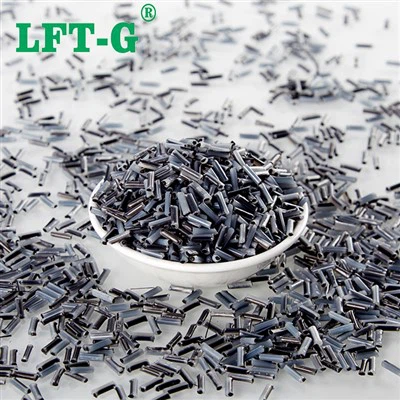


Long Carbon Fiber CF30 PPS Polymer
LCF30 PPS polymer is a composite material made of polyphenylene sulfide (PPS) and 30% carbon fiber, resulting in significantly enhanced mechanical strength, stiffness, dimensional stability, and thermal resistance compared to pure PPS pellet. The "LCF30" designation specifically stands for "long carbon fiber" at a 30% content. This combination of materials creates a composite with enhanced properties, making it suitable for demanding applications in various industries.
We should clearly understand that the initial cost of LCF30 PPS is usually higher than that of many traditional engineering plastics, but its total cost of ownership in specific applications is often lower. So this high-performance engineering plastic is used in demanding applications across automotive, chemical, and electronics industries, including corrosion-resistant parts, high-voltage electrical components, and precision mechanical parts.
Core Advantage of CF30 PPS Material
Outstanding mechanical properties: The addition of long carbon fibers significantly enhances the tensile strength, stiffness and bending modulus of the material, far exceeding that of unfilled PPS pellet. At the same time, it also improves the impact resistance and creep resistance.
High heat resistance: PPS is renowned for its high-temperature stability. LCF30 PPS composite can be used continuously in high-temperature environments.
Dimensional stability: This material has a low thermal expansion coefficient, which helps it maintain its shape and precise tolerances under high temperature and high humidity conditions.
Chemical resistance and electrical properties: LCF30 PPS plastic pellet inherits the excellent chemical resistance of PPS, being inert to various chemicals such as acids, bases, and solvents. Additionally, it has good electrical insulation properties, while carbon fibers provide a conductive path, which can be used for electromagnetic shielding and static dissipation.
LCF30 PPS: Application Range
With its powerful performance, LCF30 PPS material is often used as a lightweight alternative to metals and is widely applied in various industries:
Aerospace industry: For structural components and internal parts that require high strength, lightweight, and resistance to extreme temperatures.
Automotive industry: Components commonly found under the hood, such as engine parts, electric vehicle battery casings, and structural reinforcements, where heat resistance and weight reduction are of critical importance.
Electronic products: This material is used in connectors, electronic enclosures and other components that require high-temperature performance, dimensional stability and electromagnetic shielding.
Industrial field: Applied to pumps, valves, and other mechanical parts operating in harsh and corrosive environments.

How Does Microstructure Determine Macroscopic Properties?
The outstanding performance of LCF30 PPS compound resin is not accidental but a direct result of its microstructure design. Long carbon fibers are not simply mixed into the PPS resin; instead, they exist in the matrix in a continuous or nearly continuous form. The characteristic of these "long" fibers is the key difference from short fiber reinforced composite materials:
Efficient load transfer: Long fibers can transfer stress more effectively throughout the material. When the material is subjected to external force, the load is transferred from the soft PPS matrix to the hard carbon fibers, thereby significantly enhancing the strength and stiffness of the material. In contrast, the end effect of short fibers (i.e., the inability of the load to be effectively transferred at the fiber ends) results in limited performance improvement.
Fiber network effect: Long fibers form an interwoven network structure within the material. This network is like a strong framework, significantly restricting the creep and deformation of the matrix under high loads, and endowing the material with excellent dimensional stability. This is particularly important in the manufacturing of precision components, ensuring that the parts do not change shape over time.
Anisotropy: Due to the fact that fibers usually align along the flow direction during injection molding, the performance of LCF30 PPS plastic pellet exhibits anisotropy. This means that the strength and stiffness along the fiber direction are much higher than those perpendicular to the fiber direction. Engineers must fully consider this characteristic when designing parts and optimize the fiber orientation to maximize the performance of the components.

The manufacturing of LCF30 PPS (long carbon fiber reinforced pooyphenylene sulfide) components requires specialized injection molding technology. The presence of long fibers makes the material less fluid than ordinary PPS pellet, requiring higher injection pressure and more precise temperature control. Additionally, to prevent the fibers from being cut into shorter fibers during the processing, specially designed screws and molds are needed to maintain the integrity and length of the fibers. Although the processing process is relatively complex, the rewards it brings are higher performance, which makes LCF30 PPS plastic pellet an ideal choice for many demanding applications.
By deeply understanding its microstructure, processing characteristics and economic advantages, we can better utilize the potential of this material and provide strong support for future innovative designs.
Furthermore, the recallability of this material is also an important aspect of its sustainable development. Through appropriate recycling techniques, the discarded LCF30 PPS components can be reprocessed and utilized, thereby reducing resource consumption and environmental impact.
FAQ
Q: What are the differences between LCF30 PPS and ordinary PPS pellet?
A: Compared with ordinary PPS, LCF30 PPS composite significantly enhances tensile strength, stiffness, creep resistance and dimensional stability. The addition of long carbon fibers makes it a lightweight alternative to metals for structural applications.
Q: Why choose long carbon fiber (LCF) instead of short carbon fiber?
A: The long carbon fibers form a continuous framework network within the material, which can more effectively transfer loads and inhibit creep. This enables LCF30 PPS material to exhibit superior performance in high-load and high-temperature environments, while short fibers cannot achieve the same effect.
Q: Is the processing procedure of LCF30 PPS polymer complex?
A: Compared to the unfilled PPS, the processing of LCF30 PPS plastic granule requires more specialized equipment and techniques, such as specially designed injection machine screws and molds, to ensure that the long fibers are not damaged during the molding process, thereby maintaining the best performance of the material.
LCF30 PPS compound resin is not merely a material; it represents an important direction of composite material technology in engineering applications.
The LCF30 PPS material of LFT-G® has been widely welcomed by numerous manufacturers. This material is also in the process of development. If you are interested in it and want to know more information, you can contact our material experts. Click below,
Hot Tags: cf30 pps polymer, China, manufacturers, suppliers, factory, buy, customized