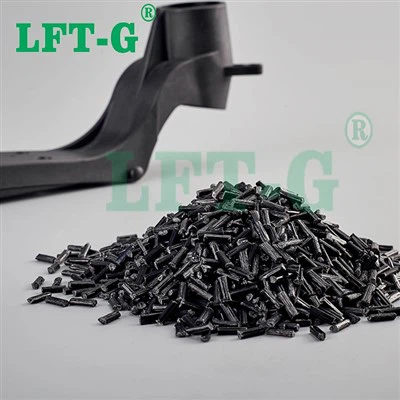

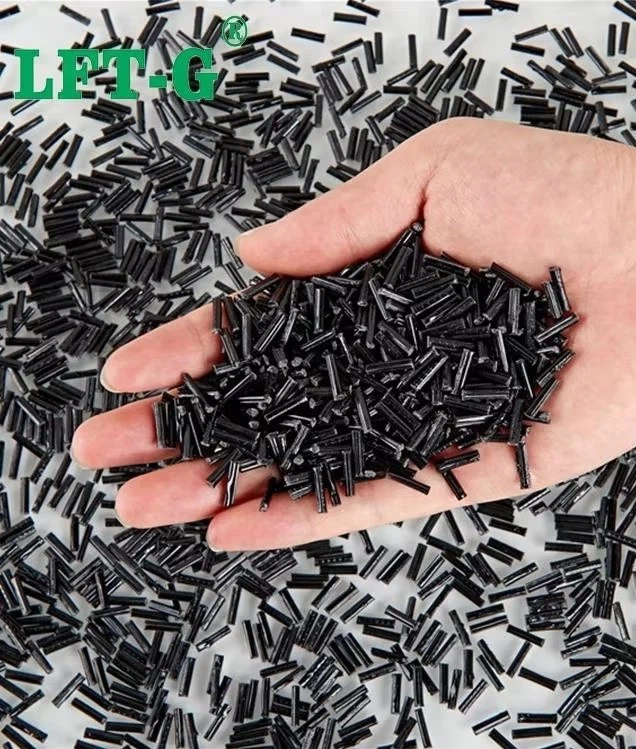
LFT-G LCF40 PP Composite
Product Overview
-

Unlike traditional short fiber reinforced materials, LCF40 PP can effectively retain the fiber length during the compounding and processing stages. It forms a continuous or semi-continuous load-bearing structure within the material, thereby significantly enhancing mechanical properties and long-term stability.
Material Architecture
Polypropylene Matrix System
The LCF40 PP uses high-purity polypropylene resin as the matrix and optimizes the control of its rheological properties and crystallization behavior, possessing the following characteristics:
Stable melt flowability, ensuring processing consistency
Excellent chemical corrosion resistance
Low density, achieving lightweight design
Extremely low hygroscopicity, avoiding performance fluctuations
This matrix not only ensures full immersion of carbon fibers but also serves as a key medium for stress transfer.
Long carbon fiber reinforced system (40%)
The material contains approximately 40% by mass of long carbon fibers, which remain at a millimeter-level fiber length after processing, forming an effective reinforcement network structure.
Its main performance contributions include:
Providing high tensile strength and bending strength
Significantly enhancing the material's modulus and rigidity
Enhancing the energy absorption capacity for impact
Improving the fatigue resistance under cyclic loading
LCF40 PP: TDS and Feature
|
Specific Gravity
|
1.00-1.40 |
g/cm³
|
ASTM D-792
|
|
Tensile Strength
|
110-130 |
MPa
|
ASTM D-638
|
|
Tensile Modulus
|
16000-17000 |
MPa
|
ASTM D-638
|
|
Flexural Strength
|
130-150 |
MPa
|
ASTM D-790
|
|
Flexural Modulus
|
12000-13000 |
MPa
|
ASTM D-790
|
|
Deflection Temperature
(1.8MPa)
|
150-170 |
°C
|
ISO 75-2
|
|
Melt Temperature
|
210-250 |
°C
|
|
|
Mould temperature
|
35-75 |
°C
|
1. High rigidity and high strength
Significant improvement in tensile strength and bending strength
High bending modulus, making the structure less prone to deformation
Can maintain shape stability even under load conditions
2. Excellent lightweighting
Significantly reduces weight compared to metal materials (steel, aluminum)
Helps with weight reduction design at the system or entire machine level
Can lower transportation and energy consumption costs
3. Excellent fatigue resistance and creep resistance properties
Strong creep resistance, with minimal deformation under long-term stress
Better fatigue resistance than short-fiber reinforced materials
Less likely to experience performance degradation under repetitive stress conditions
4. Excellent dimensional stability
Low thermal expansion coefficient (CTE)
Extremely low water absorption rate
Controllable warping and shrinkage after molding
Favorable for high-precision assembly and consistency control of structural components.
5. Excellent environmental and chemical resistance
Resistant to acids, alkalis and salt solutions
Tolerant to a variety of industrial chemicals
Not easily affected by humid environments
What is CF40 PP Used For?




Automotive Industry
One of the most typical and widely used application directions of LCF40 PP is for automotive structural components.
Typical application components: Front-end module frame, dashboard crossbeam, seat frame and supporting structure, battery pack components (for electric vehicles), internal reinforcement for car doors
Appliances and consumer structural components
They are also applied in high-end appliances or in special demand scenarios.
Typical applications: Internal support structure of washing machines, structural framework of air conditioners, high-strength connecting components



Sports and outdoor equipment components
Suitable for products that require "strength + lightweight".
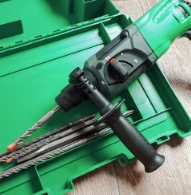
Typical applications: Structural components of fitness equipment, support frames for outdoor equipment, structural parts of tools.
Electrical tool and equipment housing structure
In electrical tools and equipment, LCF40 PP is commonly used for the internal load-bearing structure.
Typical applications: Internal support frame of electrical tools, motor fixing bracket, structural reinforcement housing
Quality Assurance
Key control points during production:
Fiber length retention rate
Accuracy of fiber content (40%)
Dispersion uniformity
Interface bonding quality
Each batch of products has undergone strict testing to ensure consistency in performance.
FAQ
Q: How is the high-temperature resistance of the LCF40 PP material?
A: The heat distortion temperature of LCF40 PP is usually above 150℃ and it can be used for a long time in an environment of approximately 120℃. However, it is not suitable for continuous high-temperature conditions.
Q: Is the material prone to deformation or warping?
A: Under reasonable processing conditions, LCF40 PP exhibits excellent dimensional stability. Its low thermal expansion coefficient and long fiber structure can effectively reduce the risk of warping, but the mold design and fiber orientation still need to be optimized.
Q: Does LCF40 PP support custom development?
A: Support. The performance can be adjusted according to the requirements, such as enhancing toughness, flame retardancy, conductivity or weather resistance, to match the specific application scenarios.
Q: Is the processing difficult? Do special equipment need to be used?
A: No special equipment is required. Regular injection molding machines can be used for processing. However, it is recommended to use a low shear screw and optimize the injection molding parameters to reduce fiber breakage and maintain material performance.
LCF40 PP is a high-performance composite material that achieves a balance between performance and processability. Through the reinforcement with long carbon fibers and the optimization of the polypropylene matrix design, this material can provide stable and reliable performance in various structural applications.
If you are also interested in the PP material of LFT-G®, then come and discuss it with us! Click below,
Hot Tags: lft-g lcf40 pp composite, China, manufacturers, suppliers, factory, buy, customized