


Ultra-High Modulus Long Carbon Fiber Reinforced Nylon 66
-
What is PA66 LCF50 Material?
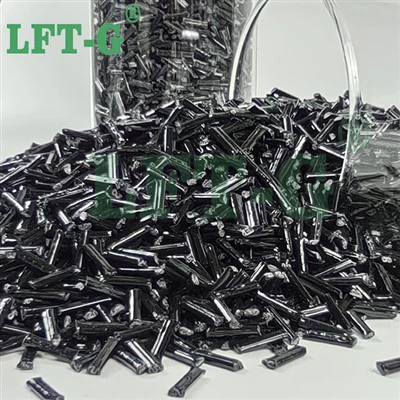
LFT-G® PA66 LCF50 is an ultra-high modulus long carbon fiber reinforced PA66 compound built for the most demanding metal-replacement jobs. With 50% continuous carbon fiber running the full length of each pellet, it delivers stiffness and strength that sit far beyond glass-fiber nylon and even beyond most short-carbon-fiber PA66 grades, while the nylon 66 matrix adds a 254 °C heat deflection temperature and excellent resistance to oils, fuels and automotive fluids.
The continuous carbon network also creates an electrically and thermally conductive path inside the part, opening up static-dissipative and EMI-shielding designs that glass fiber simply cannot support. Combined with very low molding shrinkage, this grade lets engineers replace die-cast aluminum, magnesium and titanium brackets with a single injection-molded part that holds its geometry under sustained load and elevated temperature.
-
Main Advantages
Metal-Class Stiffness & Strength
Tensile modulus around 34,000 MPa and flexural strength near 392 MPa put this grade in the same design space as light metal castings.
Extreme Heat Resistance
HDT of 254 °C at 1.8 MPa supports under-hood, engine-bay and power-electronics environments where ordinary nylons soften.
Conductive & EMI-Ready
The continuous carbon network provides a path for static charge and heat, enabling EMI-shielding and static-dissipative housings without extra coatings.
Near-Zero Warpage
Molding shrinkage of only 0.10–0.20% and a long-fiber skeleton keep large flat parts flat and hole positions repeatable.
Metal Replacement Design Freedom
Integrated ribs, bosses and snap features replace multi-piece metal assemblies, cutting machining, fastening and assembly cost.
-
Performance Edge: Long Carbon Fiber vs. Short Carbon Fiber
Continuous long carbon fiber (LCF) carries load across a much longer effective length than short carbon fiber (CF) compounds, so stress concentrates less at fiber ends. At the same 50% loading, that translates into better stiffness retention, lower creep, longer fatigue life and noticeably less warpage in large structural parts.
LFT-G® PA66 LCF50 vs. PA66 CF50 (Short Carbon Fiber)

-
PA66 LCF50 Technical Data Sheet
| Property | Value | Test Method |
|---|---|---|
| Specific Gravity | 1.33 g/cm³ | ASTM D-792 |
| Tensile Strength | 287 MPa | ISO 527 |
| Tensile Modulus | 33,963 MPa | ISO 527 |
| Tensile Elongation | 0.5 – 1.5 % | ISO 527 |
| Flexural Strength | 392 MPa | GB/T 9341 |
| Flexural Modulus | 21,918 MPa | GB/T 9341 |
| Notched Izod Impact | 31 kJ/m² | ISO 180 |
| Notched Charpy Impact | 30 kJ/m² | ISO 179 |
| Heat Deflection Temp. (1.8 MPa) | 254 °C | ISO 75-2 |
| Molding Shrinkage | 0.10 – 0.20 % | ASTM D-955 |
| Flame Retardant | HB @ 1.5 mm |
ASTM D-635 |
-
Processing Guidelines – Injection Molding
PA66 LCF50 runs hotter than PA6 grades and needs careful drying because nylon 66 absorbs moisture quickly. Use the parameters below to keep fiber length and part performance intact.

Pre-drying
3–5 hrs @ 100–120 °C
Dehumidifying dryer, moisture < 0.05%
Melt Temperature
267 – 299 °C
Measured in barrel
Mold Temperature
80 – 110 °C
Measured, not set
Injection Pressure
90 – 150 MPa
Free-flow check valve
Molding & Cooling
Full-round runners Ø 5–6 mm
Gate ≥ 5 mm · 100+ ton clamp
-
Performance-Driven Solutions
LFT-G® PA66 LCF50 is engineered for extreme-load, high-temperature and conductive-critical applications where glass-fiber nylon reaches its limit.

Engine-Bay Structural Brackets
Turbocharger pipe supports, exhaust-adjacent brackets, engine-mount arms and heat-shield frames. The 254 °C HDT and ultra-high modulus let one molded part replace a welded steel bracket without softening in continuous engine-bay heat.

Robotic Arms & Exoskeleton Joints
Heavy-payload robot arm segments, harmonic-drive housings, exoskeleton load paths and AGV suspension links. Metal-class bending stiffness at a fraction of aluminum's weight reduces inertia and motor sizing while keeping joint alignment stable.

HV Connectors & EMI Shielding Housings
High-voltage connector shells, inverter and DC-DC housings, motor-controller frames and sensor enclosures. The continuous carbon network provides static dissipation and EMI shielding in the same molded part, eliminating secondary metallization steps.
Q: How is PA66 LCF50 different from short carbon fiber PA66 CF50?
A: Both use 50% carbon fiber, but PA66 LCF50 keeps the fiber continuous through the pellet, so the molded part retains a much longer effective fiber length. That gives better stiffness retention, lower creep, longer fatigue life and less warpage than short-carbon-fiber PA66 at the same loading.
Q: What is the heat resistance of PA66 LCF50?
A: The heat deflection temperature is 254 °C at 1.8 MPa per ISO 75-2, noticeably higher than glass-fiber PA6 or PA66 grades. It suits continuous service in engine bays, power electronics and industrial equipment exposed to sustained heat.
Q: Is PA66 LCF50 electrically conductive?
A: The continuous carbon fiber network gives the compound a conductive path, which supports static-dissipative and EMI-shielding designs. Conductivity level depends on part geometry and fiber orientation, so confirm the target surface resistivity with our technical team for your specific application.
Q: What drying conditions does PA66 LCF50 need?
A: Dry at 100–120 °C for 3–5 hours in a dehumidifying dryer and keep moisture below 0.05% before molding. Nylon 66 absorbs moisture faster than PA6, so verify the dew point and avoid leaving dried pellets exposed to shop air.

Contact: Emily
Email: sale04@lfrtplastic.com
WhatsApp / Mobile: +86 188 5034 4811
Hot Tags: pa66 lcf50 holds stiffness in engine-bay heat, China, manufacturers, suppliers, factory, buy, customized


