

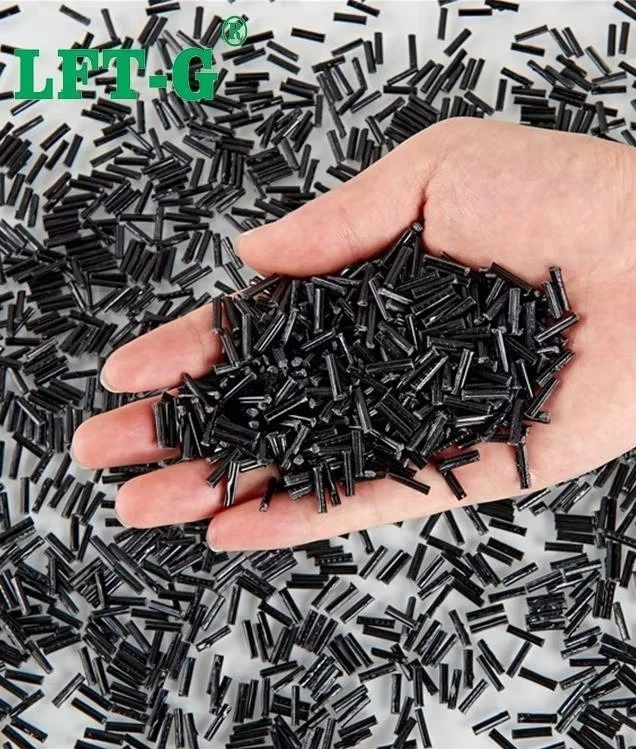
LFT‑G® PA66‑LCF40 | 40% Long Carbon Fiber Reinforced Nylon 66

What is PA66‑LCF40?
LFT‑G® PA66‑LCF40 is an advanced engineering thermoplastic composed of Nylon 66 (PA66) reinforced with 40% long carbon fibers (LCF). Engineered for high‑load, high‑stiffness applications, this long-carbon-fiber-reinforced compound delivers extraordinary tensile strength, ultra‑high flexural modulus, and permanent electrical conductivity – far surpassing conventional glass-fiber-reinforced PA66 grades.
The continuous carbon‑fiber network creates a 3D conductive reinforcement architecture within molded parts, providing excellent creep resistance, low warpage, and dimensional stability for metal‑replacement solutions in automotive, industrial automation, and electronic applications.
Key Performance Advantages
Ultra‑High Stiffness & Tensile Strength
Reinforced with long carbon fiber, the material boasts excellent stiffness and tensile properties, outperforming conventional glass-fiber-filled PA66. It achieves metal‑level rigidity while significantly cutting weight.
Permanent Electrical Conductivity
The inherent continuous carbon‑fiber network provides stable static‑dissipative and conductive performance that will not degrade over time, better than coating‑based or short‑fiber conductive materials.


High‑Temperature Stability & Creep Resistance
It delivers outstanding high‑temperature stability and creep resistance, supporting long‑term service under hot engineering conditions and maintaining stable dimensional performance for precision-assembled parts.
Lightweight Metal Replacement & Low Warpage
Lighter than glass‑fiber reinforced PA66, aluminum, and steel, it enables effective lightweight metal substitution. It allows one‑shot precision molding for complex structural geometries.
Long Carbon Fiber vs. Short Carbon Fiber
This chart compares core performances between PA66‑LCF40 (long carbon‑fiber) and PA66‑CF40 (short carbon‑fiber). Thanks to its interlocking continuous long‑fiber network, PA66‑LCF40 achieves superior stiffness, creep resistance, and high‑temperature dimensional stability. It also delivers lower warpage, improved toughness, and more lasting conductive performance, making it ideal for high‑load and precision engineering parts.

Typical Material Properties – PA66‑LCF40
| Property | Test Method | Value |
|---|---|---|
| Specific Gravity | ASTM D‑792 | 1.31 g/cm³ |
| Molding Shrinkage (1/8 in section) | ASTM D‑955 | 0.10 – 0.20% |
| Tensile Strength | ISO 527 / ASTM D‑638 | 271 MPa |
| Tensile Modulus | ISO 527 / ASTM D‑638 | 31,852 MPa |
| Tensile Elongation at Break | ISO 527 / ASTM D‑638 | 0.7 – 1.5% |
| Flexural Strength | GB/T 9341 / ASTM D‑790 | 373 MPa |
| Flexural Modulus | GB/T 9341 / ASTM D‑790 | 20,557 MPa |
| Notched Charpy Impact (23°C) | ISO 179 | 26 kJ/m² |
| Heat Deflection Temperature (1.8 MPa) | ISO 75‑2 | 254°C |
Where PA66‑LCF40 Performs

Robotics & Precision Automation
Robot end effectors, gripper jaws, tool changers, and linear motion carriages rely on PA66‑LCF40 for its combination of extreme stiffness and built‑in static dissipation. The carbon‑fiber network eliminates static buildup that can damage sensitive components, while the 31,852 MPa tensile modulus keeps robotic arms rigid and precise at high cycling speeds.
Semiconductor & Cleanroom Equipment
Wafer handling arms, chip tray nests, test socket frames, and cleanroom conveyor components demand materials that are simultaneously rigid, conductive, and particle‑free. PA66‑LCF40 delivers permanent ESD protection without coatings that shed or wear, and its low warpage ensures micron‑level dimensional repeatability across thousands of cycles.

High‑Load Automotive & E‑Mobility Structures
Battery module end plates, motor mounting brackets, suspension link inserts, and transmission actuator housings benefit from PA66‑LCF40's metal‑like rigidity at one‑fifth the weight of steel. The carbon‑fiber reinforcement maintains structural integrity under vibration and thermal cycling, while inherent conductivity supports battery pack grounding and EMI shielding requirements.
FAQ
Q: What makes PA66‑LCF40 different from glass‑fiber reinforced PA66?
A: The key difference is the reinforcement type. PA66‑LCF40 uses long carbon fibers (LCF) instead of glass fibers, delivering 3× higher stiffness (31,852 MPa tensile modulus), 40% lower density (1.31 g/cm³), and permanent electrical conductivity. Glass‑fiber PA66 is insulating, heavier, and less dimensionally stable under load – while PA66‑LCF40 is conductive, lighter, and far more rigid.
Q: Is PA66‑LCF40 permanently conductive or does it rely on surface coating?
A: Permanently conductive. The long carbon fiber network runs throughout the entire part cross‑section, providing bulk‑inherent static dissipation that does not degrade with wear, abrasion, or cleaning – unlike conductive coatings or short‑fiber compounds that lose performance over time.
Q: What processing equipment is required for PA66‑LCF40?
A: Standard injection molding machines with a low‑compression screw and free‑flow check valve are recommended. Drying at 85–110°C for 3–5 hours is essential to reduce moisture below 0.05%. Maintain the melt temperature at 267–299°C and the mold temperature at 80–100°C to optimize surface finish and mechanical performance.

Request Custom Material Solutions
Hot Tags: pa66 lcf40 | esd resistant engineering plastic, China, manufacturers, suppliers, factory, buy, customized


