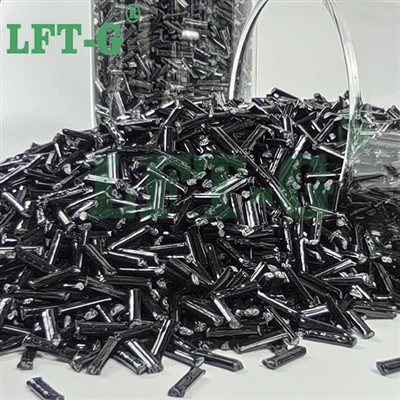

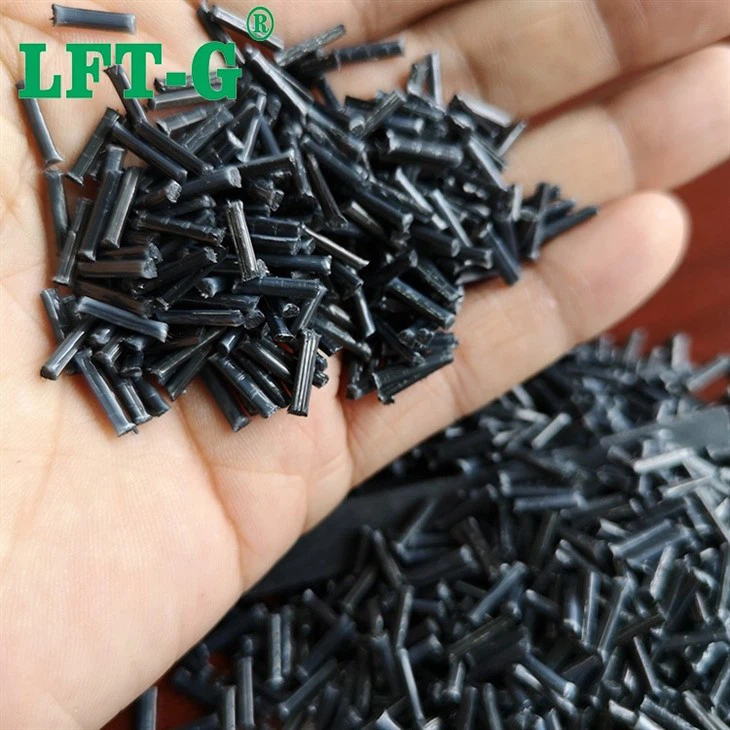
LFT-G® PA6 CF50 (LCF50) – The Ultimate Metal Replacement
Core Advantages:
- ● Hyper-Rigidity: 32 GPa stiffness eclipses standard aluminum alloys.
- ● Impact Mastery: Continuous fiber network eliminates chopped-carbon brittleness.
- ● Weight Efficiency: 1.32 g/cm³ density enables extreme lightweighting.
- ● Built-in EMI/ESD: Inherent electrical conductivity protects sensitive electronics.
The CF50 Reality Check: Micro-Structural Anatomy
Many engineers specify standard carbon fiber nylon only to experience catastrophic part failure. The secret lies in stress dissipation at the micro-level. See why LCF50 is structurally superior.
Stress Concentration (Brittle)
Fibers are milled (<1mm). Upon impact, kinetic energy isolates at the fiber ends, causing the polymer matrix to instantly fracture. High stiffness, zero toughness.
Stress Dissipation (Tough)
Pultrusion preserves 10-12mm fibers. The continuous 3D mesh acts as an internal shock absorber, distributing energy across the entire part to prevent cracking.
Technical Specifications: LFT-PA6-LCF50-BC05A
| Property | Test Standard | Unit | Typical Value |
|---|---|---|---|
| Matrix Resin | - | - | PA6 (Nylon 6) |
| Reinforcement | ISO 1172 | % | 50% Long Carbon Fiber |
| Density | ISO 1183 | g/cm³ | 1.31 - 1.32 |
| Tensile Strength | ISO 527 | MPa | 300 - 310 |
| Tensile Modulus | ISO 638 | MPa | 32,000 - 34,000 |
| Surface Resistivity | IEC 60093 | Ω | 10¹ - 10² (Conductive) |
Multi-Industry Hyper-Performance

Medical Exoskeletons & Prosthetics
In medical mobility devices, every gram directly impacts user comfort. Our 50% LCF composite provides the 32 GPa load-bearing strength of titanium at a fraction of the weight, enabling the injection molding of complex, ultra-light prosthetic joints and frames.

Robotic End-Effectors (EOAT)
High-speed automation relies on extremely stiff, low-inertia tooling. The PA6 LCF50 matrix acts as an anti-friction, high-modulus replacement for aluminum robotic grippers, drastically increasing payload capacity and motor acceleration speeds.

EV Powertrain & EMI Housings
The electrically conductive 50% carbon network acts as an integrated Faraday cage. It protects sensitive vehicle control units (ECU) from electromagnetic interference without the cost and weight of secondary metal plating or foil applications.
Frequently Asked Questions (FAQ)
Q: Why does standard PA6 CF50 break so easily compared to LCF50?
A: Standard CF50 uses milled/chopped fibers. When stress hits the part, the energy concentrates at the tiny fiber ends, causing the matrix to shatter. Our LFT-G® LCF50 maintains continuous 10mm fibers, which physically bridge micro-cracks and dissipate shock energy across the entire part.
Q: Is LCF50 electrically conductive for Electro-Static Discharge (ESD)?
A: Yes. With a highly dense 50% carbon network, the material is naturally conductive (Surface Resistivity 10¹ - 10² Ω). It provides excellent ESD protection and EMI/RFI shielding directly out of the mold, eliminating secondary coating processes.
Q: Does LCF50 require special injection molding machines?
A: It can be processed on standard machines, but due to the high abrasiveness of 50% carbon fiber, we strongly advise using bimetallic (hardened) screws, barrels, and tool-steel molds to prevent rapid equipment wear. Low-shear screw designs are also recommended to preserve fiber length.
 Stop Settling for Chopped Carbon Fiber.
Experience 32 GPa modulus with the toughness of continuous long fibers. Contact the LFT-G® team for technical support and DFM guidance.
Request PA6 CF50 (LCF50) Quote
Hot Tags: lft-g® pa6 cf50 (lcf50), China, manufacturers, suppliers, factory, buy, customized