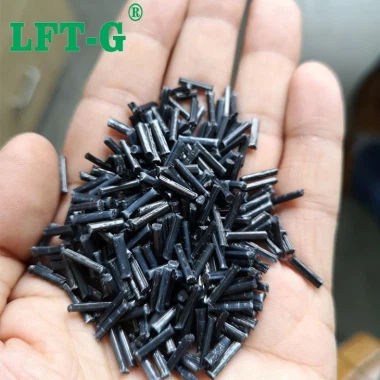


LCF PA6 Lightweight Composite
Under the background of the rapid development of new energy vehicles, intelligent equipment, high-end manufacturing, and integrated design of structure and function, the traditional material system is gradually revealing its limitations in terms of performance and efficiency. Traditional glass fiber reinforced PA6 has advantages in terms of rigidity and cost, but it is gradually encountering bottlenecks in ultra-light weighting, structural response speed, and dynamic load capacity.
For the designers and purchasers of structural components, the current common challenges are as follows:
The light weighting target is constantly increasing, but strength and rigidity cannot be compromised.
Metal materials bring weight, cost, and processing limitations in complex structures.
Traditional glass fiber reinforced PA6 has bottlenecks in terms of high dynamic loads and dimensional stability. Components are evolving from a "single-bearing" approach to a "structure + function integration" model.
Under such industry trends, relying solely on conventional engineering plastics is no longer sufficient to meet the system-level performance requirements. How to achieve weight loss while maintaining structural strength and rigidity? How can we ensure that the dimensional stability meets the requirements for high-precision assembly? LCF PA6 compound resin is precisely such an engineering plastic solution designed for high-end structural applications in this context.
What is LCF PA6 Composite?
LCF PA6 (long carbon fiber reinforced nylon 6) plastic pellet is a high-performance thermoplastic composite material made from nylon 6 (PA6) as the matrix resin and prepared through the long-cut carbon fiber reinforcement technology.
Unlike the short fiber reinforcement system, the long carbon fibers form a more complete and continuous force transmission network within the material:
Carbon fibers bear the main structural load
The PA6 matrix is responsible for stress dispersion, toughness, and processing molding
Together, they construct a stable three-dimensional structural framework
This structural design enables LCF PA6 composite to maintain the processing advantages of thermoplastic materials while achieving structural performance outputs close to those of metals.
The advantage based on the customer's concerns

Extremely high specific strength and specific stiffness
Compared to glass fiber reinforced PA6, long carbon fibers have higher strength and modulus, while having a lower density.
This enables LCF PA6 to significantly reduce the weight of components under the same load conditions, especially suitable for structural systems that are highly sensitive to weight.
For customers, this means:
Lower overall machine weight
Higher structural response efficiency Greater design flexibility
Excellent dimensional stability and structural consistency
The extremely low thermal expansion coefficient of carbon fiber ensures that the material maintains good dimensional stability under temperature changes, long-term stress, and complex working conditions.
This characteristic is particularly crucial for the following applications:
High-precision assembly structure
Modular structural components
Load-bearing components with long service life
It helps to reduce assembly deviations, deformation risks and the costs of later maintenance.


Outstanding fatigue resistance
In environments with periodic loads, vibrations and impacts, LCF PA6 demonstrates a more stable mechanical retention rate.
The long carbon fibers effectively inhibit crack propagation and delay the fatigue failure of the material.
This is particularly important for dynamic application scenarios such as robots, motion mechanisms, and vehicle components, as it can significantly enhance the service life of components and the reliability of the system.
Electrical conductivity and electromagnetic performance potential
Carbon fiber itself has certain electrical conductivity, enabling LCF PA6 to meet both structural and functional requirements in some designs, such as:
Electrostatic discharge
Electromagnetic interference shielding
Integration of structural components and functional components
Provide more material design possibilities for high-end electronic devices and intelligent systems.

Process Engineering Adaptability
1. Compatible with mainstream injection molding processes
LCF PA6 adopts a thermoplastic system and can achieve integrated molding of complex structures through injection molding, making it suitable for large-scale production.
The direct value this brings to customers includes:
Reducing metal processing and welding procedures
Lowering overall manufacturing and assembly costs
Improving product consistency and yield
2. Facilitates structural integration and parts reduction
By enhancing material properties, multiple originally separate metal or plastic components can be integrated into a single structural component, which helps to achieve:
Reduction in the number of parts
Improvement in system reliability Design simplification and supply chain optimization
What is LCF Nylon 6 Used For?

New energy vehicles
Battery system structural support components
Electric drive and control system structural framework
Lightweight load-bearing and protection components
Industrial Automation and Robotics
Mechanical Arms and Motion Support Structures
High-Stiffness Connectors
Dynamic Bearing Frameworks
Rail transit and high-end equipment
Load-bearing structural components
Integrated internal and external functional components Alternative scheme for metal structure replacement
LCF PA6 plastic pellet represents a significant direction for the development of engineering plastics towards higher performance, lightweight design, and integrated functionality.
Based on a stable long-fiber reinforced technology system, we provide customers with customizable, mass-produce, and performance-predictable LCF PA6 material solutions, helping products achieve continuous upgrades in the highly competitive market.
FAQ
Q: What processing methods can LCF PA6 be subjected to?
A: This material is suitable for injection molding and can achieve integrated manufacturing of complex structures. It supports large-scale production while maintaining good molding consistency.
Q: Why is the long carbon fiber system more suitable for structural components than the short fiber system?
A: Long carbon fibers can effectively transfer loads and inhibit crack propagation. They exhibit higher performance retention rates under fatigue, impact and dynamic loading conditions, and their structural reliability is significantly superior to that of short fiber reinforced materials.
Q: Does LCF PA6 support customized performance solutions?
A: The fiber content, mechanical properties and functional attributes can be customized according to specific application requirements, in order to meet the demands of different structures and working conditions.
Hot Tags: lcf pa6 lightweight composite, China, manufacturers, suppliers, factory, buy, customized