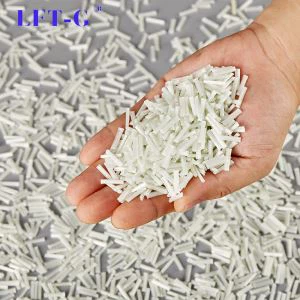


High-performance GF30 TPU Material
LGF30 TPU is an engineering-grade thermoplastic composite material developed specifically for high-strength structural applications. By incorporating a 30% long glass fiber reinforcement system, it significantly enhances the rigidity, load-bearing capacity and fatigue resistance of the material while maintaining the flexibility of traditional TPU.
This material forms a continuous reinforcing network at the microstructure level, which enables it to exhibit excellent stability and impact resistance in complex stress environments, making it suitable for industrial and structural applications with strict performance requirements.

Product Overview
LGF30 TPU (Long Glass Fiber Reinforced TPU) adopts an advanced long-fiber reinforcement process, which enables the glass fibers to maintain their length integrity to the greatest extent during processing, thereby forming an enhancement mechanism that is distinct from traditional short-fiber materials
This structure enables the material to transfer loads through continuous fiber paths when subjected to external forces, effectively reducing local stress concentration issues and delaying the crack propagation process. Compared with ordinary TPU or short-fiber reinforced TPU, this material has obvious advantages in structural stability and service life.
How to assemble LGF30 TPU?
Lorem ipsum dolor sit amet consectetur adipisicing elit.
LGF30 TPU adopts a multi-phase composite structure design, and the components within each group form a synergistic reinforcing relationship:
TPU matrix
The matrix material provides the basic flexibility, wear resistance and environmental adaptability, and determines the processing window and long-term stability of the material.
Long glass fiber reinforced system
The long glass fibers form a spatial supporting structure in the material, bearing the main load during the force application process, significantly enhancing rigidity and anti-deformation capabilities.
Interface enhancement system
By optimizing the bonding strength between fibers and the matrix through coupling agents, the load can be efficiently transferred, avoiding the phenomenon of interface separation.
This structural design enables LGF30 TPU to achieve a leap from being a "flexible material" to a "structural material" in terms of performance.
Key Performance Advantages
High strength and high modulus
The use of long fibers significantly enhances the tensile strength and bending modulus of the material, enabling it to withstand higher structural loads.
Outstanding impact resistance performance
Under impact loads, the fiber structure can disperse energy, reduce the rate of damage, and enhance safety.
Excellent fatigue resistance
Under long-term cyclic loading conditions, the material's performance degrades minimally, making it suitable for dynamic structural components.
Dimensional stability
The low thermal expansion coefficient ensures that the dimensional accuracy is maintained in an environment with temperature changes.
Wear resistance and environmental durability
The TPU matrix offers excellent wear resistance, while also possessing the properties of water resistance, oil resistance and anti-aging.
Typical Technical Data
Physical Typical Characteristic Unit Testing Standard
|
Specific Gravity
|
1.10~1.50 |
g/cm³
|
ASTM D-792
|
|
|
Tensile Strength
|
180~200 |
MPa
|
ASTM D-638
|
|
|
Tensile Modulus
|
8500~9500 |
MPa
|
ASTM D-638
|
|
|
Flexural Strength
|
260~280 |
MPa
|
ASTM D-790
|
|
|
Flexural Modulus
|
7500~8500 |
MPa
|
ASTM D-790
|
GF30 TPU: Application Range
LGF30 TPU is suitable for a wide range of high-performance application scenarios:
Automotive parts
Used for structural support components, battery assemblies and chassis systems, it achieves a balance between lightweight and high strength.
Industrial Equipment
Suitable for mechanical structural parts, protective components and shock-resistant parts, it enhances the durability of equipment.
Consumer & Sports
It is used for high-end sports equipment and industrial consumer goods, balancing structural strength with usability and comfort.

Customization Options
LGF30 TPU offers multiple customization options to meet the requirements of various applications:
Color customization (black / natural color / specified color)
Flame retardant grade (UL94)
Anti-UV modification
Optimization for low-temperature or high-temperature resistance
By adjusting the formula, a precise match between performance and cost can be achieved.
LGF30 TPU is suitable for injection molding process. However, due to its long-fiber structure characteristics, the processing parameters need to be optimized and controlled. During the processing, excessive shear rate should be avoided to prevent fiber breakage. At the same time, it is recommended to optimize the mold flow channel design to ensure a more uniform distribution of fibers, thereby enhancing the overall performance of the fabricated parts.
Something You Want to Know
What is the difference between LGF and SGF TPU?
Compared to short glass fiber TPU, long glass fiber TPU provides more efficient load transfer due to its continuous fiber length. This results in higher impact resistance, improved fatigue durability, and better retention of mechanical properties under dynamic stress conditions.
Is LGF30 TPU suitable for structural applications?
Sure, LGF30 TPU is designed for semi-structural and structural components where both strength and toughness are required. It is commonly used in automotive parts, industrial housings, and impact-resistant components.
Does LGF30 TPU require drying before processing?
Yes, drying is recommended prior to processing. Moisture can cause hydrolytic degradation of TPU, leading to surface defects and reduced mechanical properties.
What processing methods are suitable for LGF30 TPU?
LGF30 TPU composite is primarily processed via injection molding. Due to the presence of long fibers, processing parameters should be optimized to minimize shear stress and fiber breakage, ensuring optimal mechanical performance in the final part.
The products of LFT-G® undergo strict quality control during the production process, including raw material screening, online monitoring and performance testing. Through a stable production process, it ensures that materials from different batches have high consistency. Please click below,
Hot Tags: high-performance gf30 tpu material, China, manufacturers, suppliers, factory, buy, customized