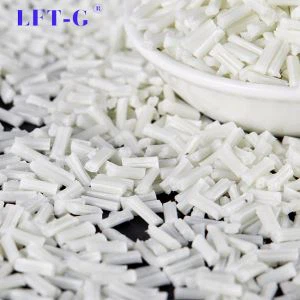


long fiber reinforced thermoplastics pp
Product Details

An understanding of long fiber reinforced thermoplastic (LFT) behavior while undergoing high energy, high strain rate impact is essential in promoting its use in automotive and other markets. In this work, damage tolerance of polypropylene (PP)/E-glass LFTs subjected to transverse blunt object impact (BOI) was investigated, treated from an experimental standpoint, in order to characterize energy dissipation and damage modes. LFT subjected to BOI exhibited high impact energy dissipation, which increased linearly with increasing areal density. The average impact energy dissipation at the critical velocity (ballistic limit) was 167 J and 121 J for a 4.61 g cm−2 specimen impacted by flat and conically shaped projectiles, respectively. The fiber orientation also played a large role in energy dissipation; failure appeared to occur along planes of preferential fiber orientation. The critical energy for specimen perforation did not vary with the mass of the impactor, i.e. strain rate, in the range investigated. This overall work advances the state-of-the-art in LFTs with an automotive focus.

Long Fiber's Uniqueness
The properties of long glass fiber reinforced parts are highly dependent on the fiber orientation generated during processing.
-Better creep resistance (cold flow)
-Consistency in holding tolerances
-Low coefficient of thermal expansion
-Uniform & predictable shrink, less anisotropic than fiber fillers
-Less prone to warp from differential cooling
-Minimize sink in heavy wall sections

Application Range
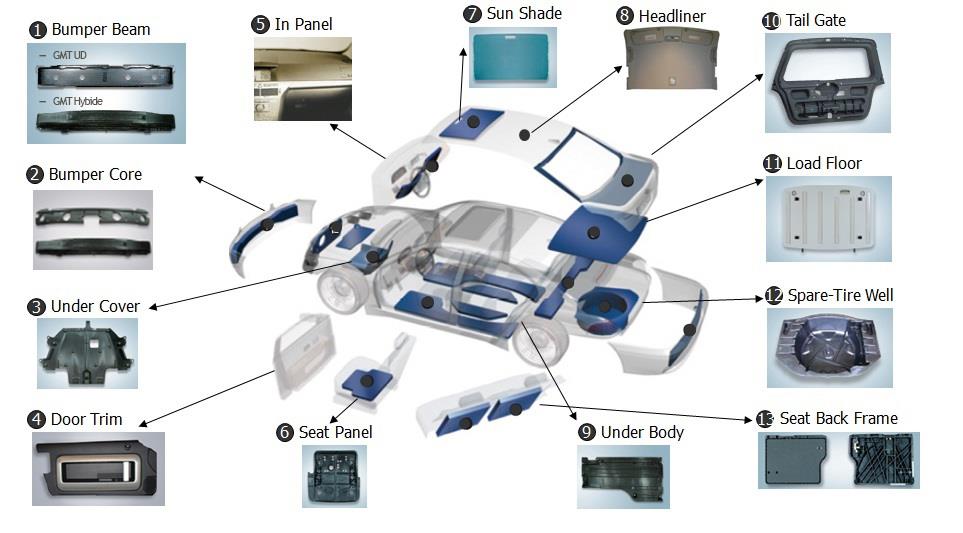
Our Team

● R&D team composed of many professional doctors and masters, over 10 years R&D and production experience in modified plastics.
● Experienced analysis and testing team, owning leading and complete experimental equipment.
● Production team with world-class factory management experience.
Contact Information
Hot Tags: Long Fiber Reinforced Thermoplastics PP, long glass fiber reinforced pp, pp lft, pp lfrt