

In engineering materials selection, designers commonly search for standard PP GF40 (40% short glass fiber reinforced Polypropylene) to handle rigid, structural applications. However, standard short-fiber composites often fall short under heavy fatigue, repetitive vibration, or low-temperature impact. LFT-G® LGF40 PP serves as the direct, high-performance long glass fiber upgrade to standard PP GF40, bridging the mechanical performance gap while maintaining cost efficiency and processing simplicity.
1. LFT-G® LGF40 PP: The Structural Evolution of PP GF40
Standard PP GF40 utilizes short glass fibers that are chopped to microscopic lengths (typically less than 1.0 mm) during extrusion. While this adds basic tensile strength, it cannot prevent crack propagation under high impact.
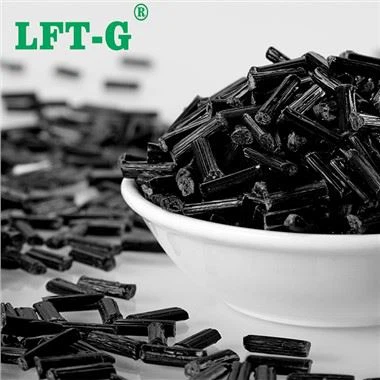
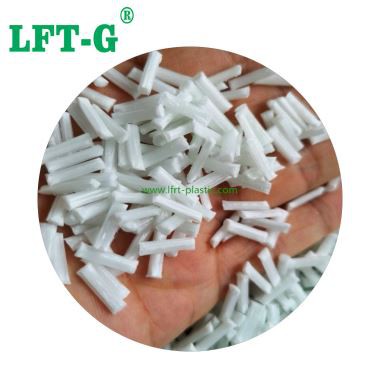
LFT-G® LGF40 PP is manufactured using a pultrusion melt-impregnation process. The glass fibers run continuously throughout the 10-12 mm pellet. When molded, this forms a 3D entangled fiber network skeleton that distributes mechanical loads uniformly, providing unmatched structural integrity.

Figure 1: LFT-G® Long Glass Fiber PP Material Pellets
2. Technical Comparison: Standard PP GF40 vs. LFT-G® PP LGF40
To highlight the performance improvements achieved by upgrading from standard short-fiber composites to long glass fiber solutions, compare their physical and mechanical characteristics:
| Key Property | Standard PP GF40 (SGF) | LFT-G® LGF40 PP (LGF) | Performance Gain |
|---|---|---|---|
| Tensile Strength (MPa) | 90 – 105 | 120 – 140 | +30% Increase |
| Flexural Strength (MPa) | 140 – 155 | 180 – 200 | +25% Increase |
| Charpy Notched Impact (kJ/m²) | 7.5 – 9.0 | 17.0 – 22.0 | +100% (2x Impact Strength) |
| Creep Resistance | Moderate (Prone to deformation) | Outstanding (Continuous Loading) | Long-term Dimensional Stability |
| Molded Warpage Index | High (Anisotropic Shrinkage) | Very Low (Isotropic Uniformity) | Prevents Structural Twisting |
Download Complete LFT PP GF40 Data Sheet PDF

3. Injection Molding Parameters & Technical Guidance
Unlike standard PP GF40 (short fiber), which is less sensitive to high shear, processing LGF40 PP requires strict control over injection molding parameters to protect the long glass fiber length. High shear will crush the fiber network, reducing the part to short-fiber performance. Follow these technical guidelines:

• Drying Settings: Dry at 75°C to 85°C for 2.0 hours. Even though PP matrix does not absorb water, drying removes moisture on the glass fiber sizing, preventing voids.
• Melt Temperature Profile:
- Rear Zone (Feed): 190°C – 205°C
- Middle Zone (Compression): 205°C – 215°C
- Front Zone (Metering): 215°C – 225°C
- Nozzle Temperature: 220°C – 230°C. Do not exceed 235°C to avoid polymer matrix degradation.
• Mold Temperature: Maintain at 60°C to 80°C. Higher mold temperatures help push fibers beneath the surface skin, reducing the appearance of floating fibers and improving cosmetic finishing.
• Shear Prevention Guidelines:
- Low Screw Speed: Rotate screw at 30 to 50 RPM.
- Low Backpressure: Keep backpressure between 0.5 to 1.5 bar. High backpressure will break fiber bundle lengths.
- Gate & Runner Design: Use full-round runners (minimum 6 mm diameter) and wide gates (minimum 3 mm thick) to prevent high-velocity shear friction during filling.
4. Automotive & High-Stress Applications
By upgrading standard PP GF40 to LFT-G® LGF40 PP, designers can confidently deploy this lightweight material in challenging structural areas:
• Front-End Carriers: Consolidating multiple metal sub-assemblies into a single molded thermoplastic part, improving impact resistance and decreasing weight.
• Tailgate & Door Modules: Handling high flexural loads and repetitive mechanical forces without sagging or cracking over the vehicle's lifespan.
• EV Battery Module End-Plates: Providing electrical insulation, dimensional stability, and impact crash safety.

Figure 3: Key Automotive Components Using PP LGF40 Composite
5. Leverage LFT-G® Materials Expertise
As a specialized developer and manufacturer of Long Fiber Reinforced Thermoplastics (LFT & LFRT), Xiamen LFT Composite Plastic Co.,Ltd is committed to delivering state-of-the-art polymer formulations.
Our products span long glass and carbon fiber reinforcements across various resin matrices, custom compounded to meet international OEM specifications. We provide complete technical support, including FEA structural modeling and mold flow processing assistance.

Figure 4: Xiamen LFT-G® Material Laboratory and Technical Team
Learn More LFT PP LGF Material
Hot Tags: lft-g® LGF40 PP,40%long glass fiber,PP GF40 Upgrade,Manufactur,LFT-G