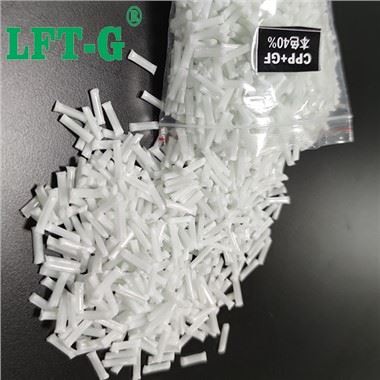


GF40 PLA Material Polylactic Acid Composite
PLA material (Polylactic Acid) is a biodegradable synthetic polymer material belonging to the polyester family. It is mainly composed of lactic acid polymerized from starch fermentation in renewable plant resources such as corn, sugarcane, cassava, etc., and is thus regarded as an environmentally friendly bio-based plastic.

What is PLA GF40 Composite?
GF40 PLA (40% Glass Fiber Reinforced Polylactic Acid) is a PLA (polylactic acid) composite material modified by adding 40% glass fiber. It combines the biodegradability of PLA and the reinforcing performance of glass fiber, significantly enhancing the mechanical strength, heat resistance and dimensional stability of PLA pellet, making it suitable for application scenarios with higher requirements for material performance. The principle of LGF40 PLA (40% long lass fiber reinforced polylactic acid) compound resin remains unchanged, except that it has been replaced with continuous long glass fibers.
40% Long glass fiber reinforced Polylactic Acid (LGF40 PLA) composites are reinforced by long glass fibers, which makes up for the deficiencies of ordinary PLA in some properties and broadens the application fields of this material. However, some details still need to be noted in the later stage. Facing the extreme performance requirements of some products, currently, LGF40 PLA material cannot stably present a good effect. However, the ideal effect can be achieved by choosing different additive materials.
What is GF PLA good for?
Key Advantage:
Higher mechanical strength (tensile, bending and impact resistance)
The "skeleton effect" of long fibers: Long glass fibers form a continuous network structure in the PLA matrix, significantly enhancing the load-bearing capacity of the material.
Tensile strength: Can reach over 100 MPA.
Flexural modulus: Higher than that of short glass fiber PLA and approaching that of engineering plastics.
Impact resistance: Long fibers can effectively absorb and disperse impact energy, reducing brittle fracture.
Superior heat resistance
The reinforcing effect of long glass fibers increases the heat distortion temperature (HDT) of PLA pellet, making it suitable for higher-temperature environments.
Better creep resistance and dimensional stability
Long fibers can suppress the deformation of PLA materials under long-term force or high temperature, reduce warpage and shrinkage, and are suitable for precision structural components.
Longer lifespan (fatigue resistance)
The continuous structure of long fibers delays crack propagation, making the material more durable under cyclic loads (such as gears and moving parts).
What is GF40 PLA Used for?
Automotive industry (lightweight components)
Interior parts: Door panel brackets, instrument panel frames, seat bases (lighter than short glass fiber PLA).
Exterior parts: Rearview mirror housing, grille assembly (can replace ABS after weather resistance optimization).
Functional parts: Battery box bracket, cable conduit (balance of insulation and mechanical strength).


Electronic and electrical appliances (heat-resistant structural components)
Housing and brackets: Router housing, power adapter housing (heat-resistant).
Connectors and slots: The dimensional stability of long glass fiber reinforcement is suitable for precision connectors.
Heat dissipation components: fan blades, heat sink frame (high rigidity + low thermal deformation).
Industrial equipment & Tools (High-strength wear-resistant parts)
Gears and bearings: Low-speed transmission components (long glass fibers delay fatigue crack propagation).
Fixtures and jigs: 3D-printed or injection-molded tooling fixtures (lighter than metal and corrosion-resistant).
Manual tools: electric drill handle, wrench (impact resistance close to glass fiber reinforced nylon).


Consumer goods & high-end packaging
Sports equipment: Bicycle pedals, climbing buckles (high strength-to-weight ratio).
Durable packaging: High-end cosmetic bottles, electronic product trays (surface can be electroplated or sprayed).
Household items: Chair frames, storage boxes (resistant to long-term loads).
Is PLA plastic biodegradable?
PLA (Polylactic Acid) plastic is generally considered biodegradable, but with some important caveats. While it can break down into natural substances like water and carbon dioxide, it requires specific, controlled conditions (like industrial composting) to do so efficiently. In typical environments, like landfills or even home composts, PLA can take a very long time to degrade, potentially years.
Similarly, even PLA materials with added glass fibers still comply with the practice of being degradable and recyclable.
Although GF PLA material is not a perfect universal solution for some components, it is a phased answer to balance ecological benefits and engineering requirements in specific application scenarios. Its true value might lie in enabling sustainable materials to break through performance boundaries and ultimately move from the laboratory to industrialization. We cannot deny the effective results brought by this material in this market.
FAQ
Q: Is PLA real plastic?
A: Polylactic Acid (PLA): The Environmentally Responsible Plastic. PLA is the talk of the sustainable packaging town. And for good reason, it's a bioplastic made from renewable, plant-based materials like corn, cassava, and sugarcane. Therefore, GF PLA material is also a kind of true plastic
Q: What are the disadvantages of PLA plastic? Can it be solved after adding fibers?
A: Comparatively low strength. The strength of PLA material with long glass fibers added has been significantly enhanced, making it capable of adapting to more demanding application scenarios.
Q: Can you make customized products?
A: Yes, we can customize the color and length of the product.
LFT-G® has also developed its own solution for this material, which can largely retain the advantages of PLA material. If you want to know more about the diversity of this material, you can contact our material experts. Let's explore together the role this material can play in modern development. Click below,
Hot Tags: gf pla polylactic acid composite, China, manufacturers, suppliers, factory, buy, customized