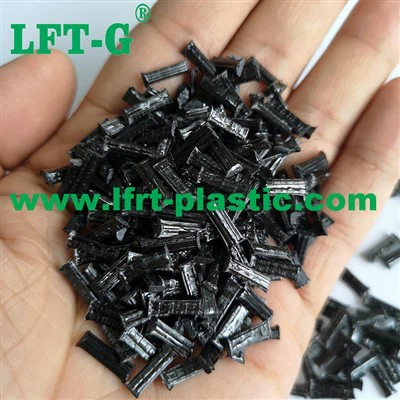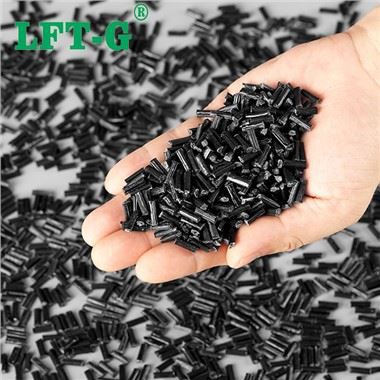

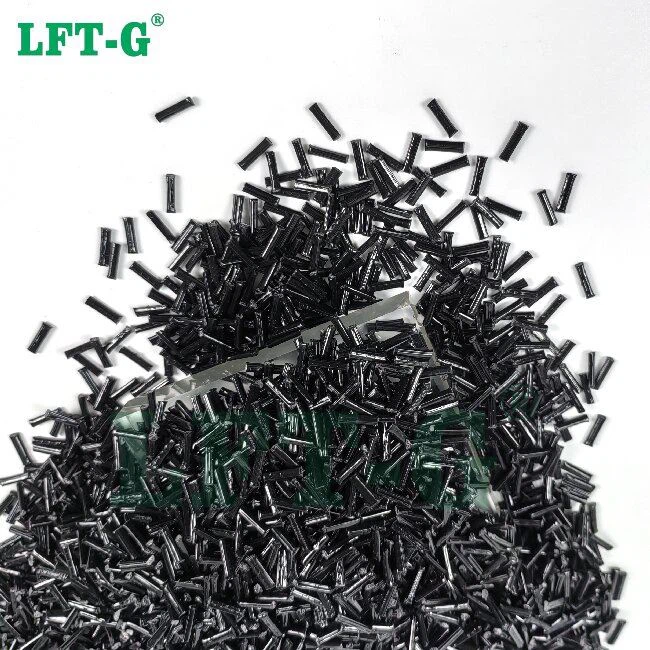
Light weight LFT-PP-BC03 Pellet
Brief Description of LCF30 PP
LCF30 PP is a high-performance composite material with polypropylene (PP, usually in a copolymer or homopolymer system) as the base material and reinforced by long carbon fibers (with a length typically ranging from 6 to 25 mm).
Carbon fiber content: 30%
Enhancement form: Long fiber continuous framework structure (non-short-cut GF/CF powder)
Molding method: Long fiber thermoplastic composite material (LFT) injection/molding
Material form: Long fiber network structure is retained in the particles (non-uniform dispersion of short fibers)
Long fiber three-dimensional network structure
Carbon fibers maintain their long length during the melt impregnation process
After molding, it forms a three-dimensional random but continuous load-bearing network
Constructing "force transfer paths" inside the part
Essential difference from short fibers (SGF/SCF)
SGF: Short fiber "point-like reinforcement"
LCF30: Long fiber "structural framework reinforcement"
LCF30 PP: Core Advantages
Mechanical Performance
Significantly enhanced tensile strength (up to several times higher than pure PP)
High rigidity (significant increase in bending modulus)
Excellent creep resistance (no deformation under long-term load)
High fatigue life (stable structure under cyclic loading)
Thermal Performance
The heat distortion temperature has been significantly increased (applicable to medium and high-temperature structural components)
It maintains high rigidity at high temperatures
The thermal expansion coefficient has been significantly reduced (resulting in more stable dimensions)
Physical Properties
Low density (typically around 1.0 - 1.30 g/cm³)
Excellent specific stiffness
High isotropic stability (more balanced than short fiber materials)
Molding Characteristics
It can be injection-molded to form complex structural components.
The fiber orientation can be controlled (the flow direction is significantly enhanced).
A wear-resistant screw/nozzle is required (carbon fibers have a higher wear resistance)

Why choose LCF30 PP Composite?
The selection of this material is usually based on the following engineering logic:
Lightweighting as an alternative to metals
Replace some structural components with aluminum alloy/steel, achieving significant weight reduction while maintaining structural strength
Requirements for high rigidity and low density
Application of "rigidity first but without increasing weight", with higher specific stiffness than traditional GF materials
Long-term load-bearing structural components
Resistant to creep (remaining unchanged under long-term stress), suitable for load-bearing structural parts
Components with high dimensional accuracy requirements
Low thermal expansion coefficient, more stable contraction, and better warpage control

What can LCF30 PP be Applied to?
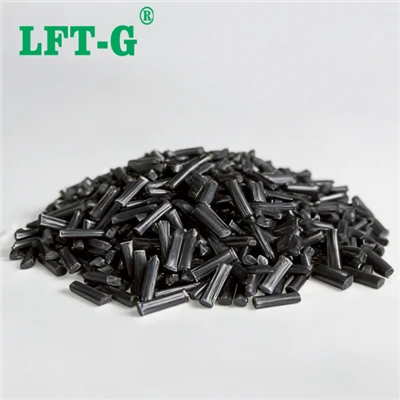
LCF30 PP plastic pellet can be applied in numerous industries and is used to manufacture various components, including automotive structural parts, industrial equipment, electronic and electrical products, household appliance structural parts, and so on.

FAQ
Q: How is LCF30 PP different from LGF30 PP?
A: LCF30 PP uses long carbon fiber, offering higher stiffness, lower density, and better fatigue resistance compared to LGF30 PP, which uses glass fiber and focuses more on cost-performance balance.
Q: Is LCF30 PP suitable for injection molding?
A: Yes. It is designed for injection molding, but requires wear-resistant screws and optimized gate design due to carbon fiber abrasion and orientation effects.
Q: What should be considered in design?
A: Fiber orientation, gate position, and load direction must be considered to fully optimize mechanical performance in final parts.
Contact Us
The core values of LCF30 PP can be summarized into three points:
✔ 1. Structural Enhancement
✔ 2. Lightweight alternative to metals
✔ 3. Long-term reliability
Hot Tags: light weight lft-pp-bc03 pellet, China, manufacturers, suppliers, factory, buy, customized